-
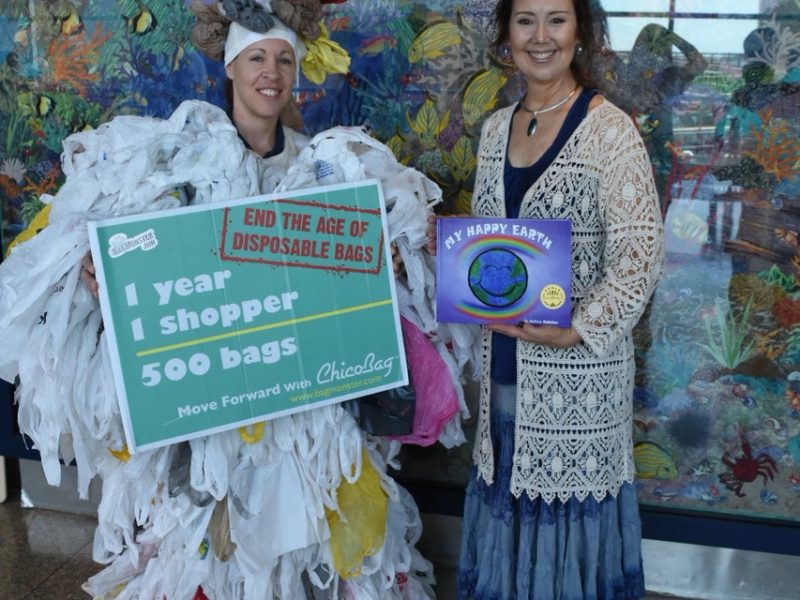
Pilot project shows that engaging visitors in conservation efforts can inspire commitments and enhance experience!
During the week surrounding World Oceans Day, 12 zoos, aquariums and museums (ZAMs) participated in a pilot project that had them asking their visitors about helping to address the…
Continue reading -
The Houston Zoo Explores Whether Artistic Displays Inspire Conservation Action!
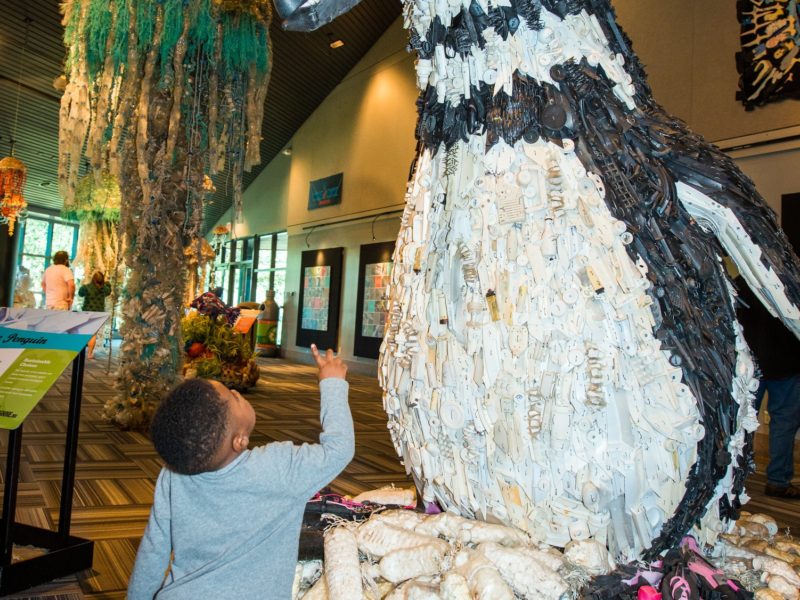
This guest post is by Martha Parker, Conservation Impact Manager at The Houston Zoo. The Houston Zoo is committed to saving wildlife through partnerships and the support of global and local conservation projects, while connecting the Houston community to wildlife at the Zoo and inspiring them to action. To help fulfill our goal of saving wildlife, the Houston Zoo has been addressing the issue of plastic pollution. We went plastic bag free in July 2015, a decision that helped reinforce our commitment to reducing plastic pollution, a major threat for marine wildlife like sea turtles, which we work diligently to protect. The Houston Zoo receives wild sea turtles who require medical care and rehabilitation support from our partners at NOAA. Some of these turtles arrive at the Houston Zoo because they have ingested plastics or are entangled in marine debris. This makes the connection between the wildlife we work to protect and the threat of marine debris quite clear for us. The Approach To further our protection efforts of local sea turtles and help connect our community to the threat of marine debris and how they could take action, we welcomed Washed Ashore to the Zoo in January of 2016. Displayed at the Zoo’s Brown Education Center, Washed Ashore was the perfect visual representation of a global issue that hits home for Houstonians living so close to the Gulf of Mexico: plastic pollution. This awe-inspiring exhibit brings to life an overwhelming problem and puts it right in front of your eyes, connecting visitors with the animals affected by trash in our oceans. The Houston Zoo not only wanted to provide a fun experience for their guests, but also wanted to inspire action to save animals in the wild with a very specific ask of going single-use plastic bag free when shopping. After some brainstorming for a fun, interactive guest experience that incorporated data collection, Zoo staff decided the best way to get guests to take a pledge to use reusable bags was to have them add their fingerprint to another artistic display, an underwater-themed mural, designed and painted by famous Houston street artist, Gonzo247. Before participating, however, guests took a short survey and committed to going plastic bag free for three months. Between January and April 2016, colorful sea turtles, sharks, rays, shore birds, and fish were filled in as 1,482 guests took the pledge and showed their commitment by adding their thumbprint to the mural wall, in the animal they were helping to protect by going plastic bag free. This challenge is important to the Zoo’s mission of saving animals in the wild and inspiring behavior change by empowering Houstonians to make a difference. But how do we know if it worked? The Results With our evaluation methods, we aimed to answer the question; do visitors to the Washed Ashore exhibit at the Houston Zoo become inspired to use reusable bags more frequently than those zoo visitors who did not? We asked visitors from both a control group and an intervention group to take the challenge to go plastic bag free for 3 months to save wildlife like sea turtles. The control group was asked this question at the sea lion exhibit before Washed Ashore opened. The intervention group included those zoo visitors who visited the Washed Ashore exhibit. Three months from the time the visitor signed up to go plastic bag free, the Houston Zoo followed up with them by email to see how they did with the challenge. In total, we had 68 participants in our control group, with only 6% responding to the 3-month follow up. Our intervention group included 1,482 participants, and we had a notably better 16% response rate, with 230 of those responded to the 3-month follow up. While the better response rate was a good indication of a positive impact from the exhibit, we did not have enough participants in our control group to answer our original research question. We did gather valuable data that we can use to influence future exhibits and messaging. For example, we confirmed that in keeping with research by The Ocean Project and others, our guests are indeed motivated to make changes in their behaviors to protect animals, and their visit to the Zoo was an important aspect of taking action. Specific to using reusable bags, we know that our messaging should include ways to remember your bags, including tips on keeping them in your car. Finally, it was a great learning experience for the Zoo to evaluate (on a small scale), the impact of our work to save wildlife by empowering our community to take action. What enabled us to be successful in our effort to connect guests to the issue of marine debris and move them to action was the collaboration across numerous departments of the Zoo, and the strong tie between the exhibit and our efforts to save ocean animals like sea turtles, locally. This project has certainly influenced the way we think and plan for future exhibits and experiences. Our advice to others…... Start planning early. Get all relevant departments/people involved so that you choose the correct exhibit for your audience. Develop an institutional goal. No matter the exhibit content, you should have an institutional goal for that exhibit determined so that planning and evaluations can take that goal into consideration. Revisit the exhibit/process at regular intervals. Avoid implementing a project and then when finished, evaluating how it went. Bring all stakeholders together frequently to see how the project is going and make changes as you go. Align messaging/content with what is relevant for your institution, your audience, and the work you do. Communicate with other organizations who have experience with the content/exhibit-find out what worked for them, what didn’t. Track your success-even seeing what didn’t work is critical information to move forward in the future Additional Data Responses from both groups in 3-month follow-up included some positive indications that we were helping to increase bag use: 43.35% of respondents used their bags “almost every time they shopped” during the 3-month challenge, compared to 16.31% of respondents used their bags “every time they shopped” during the 3-month challenge, and only 2.58% of respondents “never” used their bags when they shopped during the 3-month challenge More than 60% of survey respondents put their likelihood of continuing to use reusable bags at “extremely likely” 198 respondents have encouraged family/friends to go plastic bag free as a result of their participation in the challenge, reaching an additional ~1,379 people. It was important for the Zoo to understand the motivations behind why our guests were successful in the reusable bag challenge. We found that motivations for continuing to use reusable bags during 3-month challenge included the following: Visiting the Zoo increased knowledge of how plastic bags are a problem for wildlife was cited by more than 52% of survey respondents. “That exhibit at the zoo really did change things for me. Not just about plastic bags. I have tried to buy less plastic in general - kids dishes and bowls (switched to bamboo), kids toys (wood, fabric, handmade), and I've tried to avoid buying food that comes with a lot of extra packaging. I loved that exhibit because it shocked me to see all of the toys and bottles and things that don't just disappear, thank you for teaching me that I'm contributing even if I think I'm not!” “I have used reusable bags for many years. Mostly at the grocery store. The positive thing in my life about the challenge was not taking bags at other stores such as clothing or craft stores. Taking the challenge actually made me take my reusable bag to the next level, which is to use them everywhere including on trips.” In order to make the Zoo’s messaging more effective in the future, we also asked respondents about barriers, which included remembering their bags. 80% of respondents remembered their reusable bags by keeping them in their car. In the future, we can utilize this information to remove barriers for guests when we ask them to switch to reusable bags. (E.g. “If I forgot my bags at home, I would ask for paper, which got reused. If I forgot my bags in the car, I would just ask them not to bag my groceries and then would cart them out and put them in the bags once I got to the car. It really helped me remember to take them out of the car when I had to do this!”) Additional feedback from Houston Zoo participants: ~Great program to encourage less plastic bag use, thank you! ~I have been using only recyclable bags, mostly fabric, for more than 5 years. I was happy to see the bag challenge at the zoo! I hope you have had an excellent response from others. ~I tell the store clerks about our pledge with the zoo and encourage family to think about using reusable bags. ~The bag challenge did not work for me. I chose to reduce my use of disposable plastic bottles instead. I now have a metal water bottle and have encouraged my children to use reusable water bottles also. ~Great program. The education by the zoo raises our awareness to the damage of plastic bags. Continued education and awareness remind us and help us change our ways permanently. Thank you for all of your hard work! ~This was not easy at first! A few times I forgot my bags in the car and had to take a full cart of groceries out to the car and load them in my reusable bags in the parking lot. Ha! But it was worth it, to know that I helped. Thank you for the challenge! ~This survey is a test reminder to get back on track with using reusable bags! ~Going shopping with reusable bags is fun and fashionable. I use them where ever I shop or visit! The zoo bags are the best. I have 3 of them so far. Please design more! ~I now also recycle all my paper and plastics. Thanks to my Houston zoo visit. Was very impressed with your plastic artwork. ~I have shared this incentive through Facebook by posting photos of the zoo's exhibit and the impact on not only sea turtles, but other sea creatures as well. When I use plastic bags, I always bring them back for recycling, and never throw them in the trash. The exhibit at Houston Zoo changed my behavior absolutely, I had no idea the impact of such a simple, daily use item on wildlife. Thank you! ~It was a great experience and if it had not been for that visit at the Zoo with my grandson, I would still be using plastic bags. Now I find that it is actually so much more efficient to use my own reusable bags, because more items fit into the bag, or maybe the store packers put more into one bag. Therefore, it is also more convenient to carry it into the house. Helping to save the environment is great. Keep up with such programs. Thanks. ~I often forgot my reusable bag but I would still carry out the items rather than asking for a plastic bag. When questioned or given that unsure look by my cashier, I often responded with "I'm plastic bag free, save a sea turtle". At least twice I was asked what I meant and was able to have a short but great conversation about the subject.
Continue reading -
ISG+ Final Report: Tasting Success at the Arizona-Sonora Desert Museum
This guest post is submitted by Debbie Colodner, Director of Conservation Education and Science from the Arizona-Sonora Desert Museum, and is the last in a 3-part series on their Innovative Solutions Grants+ project where they partnered with Leading for Good to see if they can move the needle on sustainable seafood in Tucson, Arizona. With Tasting Sustainability, our effort under the Innovative Solutions Grants + Program, we wanted to go beyond Desert Museum business as usual. We understood that in order to make a difference for sustainable seafood in our desert city, we needed to go beyond efforts to raise awareness and get closer to the point of sale, particularly at restaurants. And we hypothesized that there could be a win-win in promoting sustainable seafood by reaching out to local restaurants and engaging millennial audiences. We were right! Moreover, this effort has built our confidence and capacity to go outside of our comfort zone and begin a social marketing initiative. Working with our partner in this effort, Lead Local and their Leading for Good program, our Museum staff and interns alike had opportunities to learn about how to research an audience’s interests (In this case, local restaurants’ needs, wants and constraints), as well as inexpensive and rapid methods to prototype engagement ideas. SINCE OUR LAST POST As described in our last blog post, the strategy we chose for further testing was to co-host events with local restaurants, and we were able to test three different types of events last Spring. The first was at a downtown restaurant, in concert with “Agave Week,” which is focused on agave-derived and other native and local food products. The event attracted a large, diverse crowd, and our project interns encouraged people to take a seafood watch guide, take a pledge (using a photoframe cutout) and post it to social media. Our major lesson learned was that without food/beverage samples to offer it was hard to get this audience’s attention, especially at an event with a different theme, and interns were able to distribute 30+ guides, and only 6 people took a pledge. Nonetheless, the interns enjoyed the chance to raise awareness and participate in this locally grown and growing festival, and felt like they made an impact (awareness) on the people with whom they spoke. The second event was at a more “suburban” beach-themed restaurant which is already a Seafood Watch partner. The restaurant owner acknowledged an “aha” moment when he realized that there is value in promoting that partnership to attract younger customers. He bought all new uniforms for his wait staff – t-shirts promoting sustainable seafood. The event drew more customers than usual for a Friday night in the slow season, making it a success for the restaurant. And at this event, staff from the Museum and Monterey Bay’s Seafood Watch program staffed an educational table with interactive displays outside of the restaurant. Everyone entering the restaurant saw the display materials, and most stopped to talk - in contrast to the Agave Fest, the sustainable seafood messaging was the focus in event advertising, and that helped engagement. But most of the diners were older adults, many from the Museum’s docent and volunteer corps, so still an ongoing challenge in reaching younger adults. Karin Stratton from Monterey Bay's Seafood Watch Program with participants at Fini's World Oceans Day Event, demonstrating Fini's new tee shirts for wait staff and for purchase. The third event was “World Oceans Night” at the Desert Museum. Based on the connections forged by our Interns, two new restaurants were able to attend and promote their sustainable choices, along with several non-restaurant community partners – a trend we hope to continue. Restaurant participants were pleased, indicating that with a crowd filled with many millennial-aged adults among the 900 people who attended, they would like to come again next year and that they would like to continue to partner on sustainable seafood issues, including moving toward becoming a Seafood Watch partner (for two of them). Anecdotally, we can say again that developing a seafood themed event was helpful, and with a push we did better in terms of attracting a millennial audience; however, next time we will look to have better systems in place to track engagement and the ages of those attending. Throughout this effort we’ve had great response from the local restaurants – nearly all we asked were interested in working with us on this issue, including in developing these events. And our experience suggested that the chefs were the key people with whom to work. However, our research with the restaurants and our experience at these events revealed that local awareness of sustainable seafood has not yet reached the threshold above which it would be valuable for the restaurants to tout their commitments. Somewhat ironic given that we started this project with the proposition that we needed to do more than awareness-raising! And, again, we now know that there are several restaurants in the Tucson area who see benefit in helping the Museum build this awareness, even if they are not ready to become full Seafood Watch partners. The other major goal of the project was to enhance the Museum’s engagement with younger adults (millennials), and to empower young adults to make positive change in their communities. At the start of the project, 3 of the 7 interns involved reported that they were unsure they could do anything to impact ocean health and fish populations. In the final survey, 100% of responding interns were sure they knew what they could do to make a difference! And while initial surveys revealed that most interns viewed the museum as a beautiful place to see desert wildlife, at the conclusion, one participant called the Desert Museum “a leader in conservation and collaboration to connect the community with the natural world.” We also learned that college students can be persuasive and engaging spokespeople for more sustainable seafood promotion at restaurants, and that projects like this help them develop skills for making positive change in their communities. OUR ADVICE TO OTHERS So in summary, here are some lessons for other zoos and aquariums that may want to advance sustainable seafood: Engage the power of young professionals or university students to help make the case that millennial customers care about where their food comes from Reach out to local restaurants, interview chefs and owners to gauge their awareness and interest Work with interested chefs/owners to partner on strategies to build the local sustainable seafood brand Recognize their interest and steps toward seafood sustainability, even if they may be short of full Seafood Watch partnership Encourage restaurants to promote their sustainable seafood choices more boldly, and explore opportunities for mutually beneficial events (noting that the public may not yet be aware!) Help create a network of local chefs/restaurant owners Next steps for Tasting Sustainability THIS IS NOT THE END! The Museum’s next steps in Tasting Sustainability are to further connect local Seafood Watch partners and potential partners with additional coordinated events at restaurants, and by making the network visible through the ASDM website and at our new Stingray Touch exhibit. And continue to focus on collaborating with the millennials! We will continue our efforts to put Tucson on the map as a fish friendly city and establish a model for other cities to follow.
Continue reading -
ISG+ Update: Zoo-Alive teen volunteers at the Saint Louis Zoo take the #byetobags pledge and spread the word!
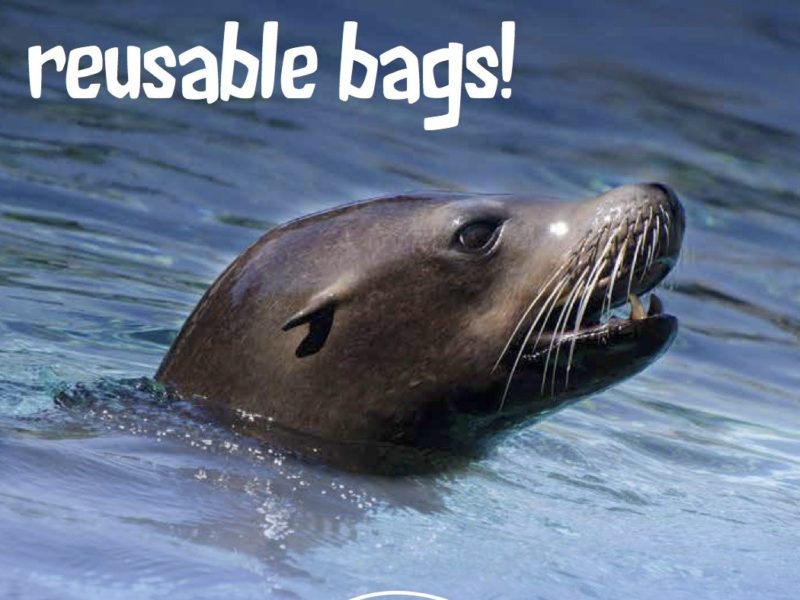
This guest post is submitted by Kirinne Slaughter at the Saint Louis Zoo, and is the second in a 3-part series on their Innovative Solutions Grants+ project. Since our last post, our Zoo ALIVE (ZA) teen volunteers have been hard at work helping Zoo visitors say #byetobags! Successfully building on the lessons learned from the Better Bag Challenge, our teens have developed a campaign that asks visitors to be a part of the plastic pollution solution by switching to reusable bags to help sea lions. The teens designed a reusable bag giveaway, and a pledge that states: “I pledge to switch to reusable bags in order to keep our oceans clean for sea lions & all ocean animals!” Since our official launch on April 23rd, they have asked more than 1200 people to take this pledge. As the main question under our grant, we wanted to know how effective social media was at amplifying an on-grounds conservation ask and, at the same time, how effective it could be as a standalone medium of asking people to take conservation action. Specifically, our teens wanted to know: Could they get visitors who took our pledge on-grounds to become active on #byetobags social media, and share the #byetobags pledge with friends and family? How many people could they get to take the #byetobags pledge just through discovery on social media, without the on-grounds bag offer? If people do share the pledge with their friends and family, which method of sharing do they use most? How can we measure all this? These were a lot of questions, and it took a lot of hard work to figure out a way to track the data that we needed to answer these questions. But, with the help of the Zoo’s marketing department and advertising agency, we developed an innovative online pledge taking platform that not only adds a level of sophistication to our campaign, but is the first online campaign of its kind at the Saint Louis Zoo. To properly track data in order to answer these questions, two separate pledge pages were created: one for visitors to sign if they visit a #byetobags table on-grounds, and another for people who accessed the effort through our social media streams or through the Saint Louis Zoo website. The forms are identical in almost every way, save for the fact that the on-grounds form is a ghost page, accessible only to #byetobags staff when on-grounds. Both forms require visitors to give their name, email and zip code. It also gives them the option to give their age, and answer the question, “how often do you use reusable bags?” Have you taken the #byetobags pledge? Do so now, and then help spread the word! The online pledge form can be found here. After taking the pledge, everyone, no matter which pledge form they use, receives an email thanking them for taking the pledge, and asking them to spread the word to their friends and family. The teens came up with three share options to choose from: Facebook, Twitter, and email. No matter which method they choose, an automatic message is provided for them to spread the #byetobags message. For example, if you were to choose to share via Twitter, the following message will be automatically tweeted from your account: “Keep sea lions safe from plastic bags in the ocean! Join us and take the pledge!" The tweet contains a link back to the #byetobags online pledge page. Because these separate pledge pages generate two separate lists of people, we are able to track whether someone took the pledge on grounds, whether they found the pledge on our social media or on the Saint Louis Zoo website. Additionally, through analysis software provided through Google, Formstack and our email service provider, Sharpspring, we are able to track through which social media channel people access the pledge, and what share option people use most often when spreading the message to their friends and family. As we continue to collect data, there seems to be no limit to the number of questions we can answer with this sophisticated software. What have we found out so far? So far, since our launch on April 23rd, the Zoo ALIVE Teen volunteers have collected data that begins to shed light on their research questions: On grounds: A total of 732 on-grounds pledges have been taken! Meaning this many more reusable bags are being put to use! Additionally, across all events at which the teen volunteers were presenting #byetobags information, 90% of the people that the teens interacted with and asked to take the pledge, did so. While relatively few of these people have shared the pledge from the email that they received, our Facebook following and reach has been increasing steadily each week, with a total Facebook reach of 17,081 people! Online: We also have seen success on our online pledge, with an additional 168 pledges received with no on-grounds interactions at all, due only to presence on social media and the Saint Louis Zoo website. Since the first posting of the online pledge link on #byetobags social media on April 26th, we have averaged around three online pledges taken per day. These pledges come mostly from people responding to our posts on social media, however we do get pledge takers who stumble upon the pledge while simply navigating the Saint Louis Zoo’s website. Which share option has proved most successful so far? Facebook has been used three times as often as other share options for spreading the word about the #byetobags pledge. Anecdotally, however, our Twitter account has garnered lots of attention from other sustainability organizations, such as St. Louis County Recycling and Coast Plastics. I anticipate that our visibility and networking with these organizations will help us greatly as we continue to spread our message into the St. Louis community at large. As we continue to move forward with this campaign… Our teens are focusing on modifying our messaging to emphasize the importance of sharing the pledge with friends and family. Additionally, they will be increasing their engagement on social media in an effort to increase the number of pledges taken online, and the number of followers on our sites. Just this past week, we unveiled a #byetobags challenge that asks followers to post a photo/video with their reusable bag. With this challenge we hope to increase awareness and engagement with our campaign. As we continue to interact with visitors throughout the summer, we expect to see these numbers increase, with more and more people joining the pledge through social media, and spreading the word! The whole Zoo says #byetobags! In addition to the primary aspect of our grant, we have also been involved in many other important parts of Zoo culture. Our gift shops have been very involved with the project. They have incorporated signs into their shops encouraging people to choose reusable bags, and ask visitors, “Do you need a bag today?” upon checkout. Additionally, our #byetobags messaging has been integrated into our Sea Lion Show. Before each show, an audio clip recorded by the Zoo ALIVE teen volunteers plays that gives an overview of the #byetobags project. During the show, the trainers explain how important reusable bags are, and give away a #byetobags reusable bag. The sea lions themselves also take part and during the show they put their “lunch” into a prop #byetobags reusable bag. https://theoceanproject.org/wp-content/uploads/2016/07/OPR-Audio-Clip-2-Final-1.mp3 Finally, we are an integral activity at our weekly summer concert series, Jungle Boogie. We have formed strong connections with visitors who attend this event each week, and they have become advocates for our project as they encourage new visitors to stop by our table. An overwhelming majority of our guests have been nothing but positive when interacting with our #byetobags table. They seem grateful for the information, and excited about receiving our help in starting to work towards more sustainable behaviors. Our next steps include continuing to work with the various departments around the Zoo and the Saint Louis community to increase the spread of our message. We will be at an increasing number of events throughout the summer, and new ZA’s have been trained and will begin working with the #byetobags campaign. Additionally, as we continue to analyze different parts of our data, we will continue to answer our research questions as to how we can most successfully amplify an on-grounds ask using social media.
Continue reading -
ISG + Update: Philadelphia Zoo’s energy study goes live!
This guest post by Wei Ying Wong of Philadelphia Zoo is a follow up to the previous blog on Philadelphia Zoo’s Innovative Solutions Grants+ project. They’re exploring a new way of evaluating long-term conservation behavior change, specifically home energy use, in visitors to the zoo’s KidZooU exhibit. We’re live! As a quick addition, we are pleased to announce that we have figured out the logistical and legal details for tracking the efficacy of our onsite messaging in changing offsite behavior, and are “live” with our collaboration with PECO. We officially launched the last weekend of January, incorporating all the lessons learned from the previous segments of the study, while adding to the pledge a permission slip that will allow us to collect information about a participating guest’s energy use and compare it with similar households (all data will be anonymous - we will not receive any personal or identifying information but we will see if energy use goes down as promised!). With our revised approach, we changed the order of our script to foreground the “ask.” And we added a second researcher so we now have one to engage the younger audience and solicit their fingerprinted pledges to “Save Energy to Save Wildlife”, while the other recruits the adults (parents/guardians) to sign the official permission slip for our study. As we are currently in our low season (not helped by some very cold weekends!), our engagement and recruitment activity has been slow. However, both engagement AND recruitment rates have been really promising since we made the changes: More than two thirds (83%) of our visitors whom we engaged are now staying through the entire interpretation (up from 48%), More than three quarters (78.6%) of the groups have someone pledge to take action (up from 42%) And half of the groups who had someone pledge to “Save Energy to Save Wildlife” were willing to sign the permission slip to participate in our study. Unfortunately only half of them lived in PECO service areas and therefore eligible to participate. Nevertheless, that still is a 30% recruitment rate! We will keep doing more of this for the next few months! For our final report under this grant, we will have good data on how willing our guests are to participate. But by the end of summer, however, we will be able to tell you even more about whether we managed to make a difference.
Continue reading -
ISG+ New Project: Zoo ALIVE Teen Volunteers at the Saint Louis Zoo say #ByetoBags … and ask that you do too!
This guest post is submitted by Kirinne Slaughter at the Saint Louis Zoo, and is the first in a 3-part series on their Innovative Solutions Grants+ project. Building on the Better Bag Challenge Zoo ALIVE teen volunteer For more than a decade, the Zoo ALIVE (Active Leaders In Volunteer Education) Teen Volunteers at the Saint Louis Zoo have been educating zoo visitors, zoo campers and the St. Louis community about animals, their habitats and conservation. Now, for the first time, thanks to the support from The Ocean Project’s Innovative Solutions Grant+, these teen volunteers will aim not only to inform, but also to inspire others-onsite and online-to take action on one of the biggest issues facing the environment today: plastic pollution, particularly from single-use plastic bags. To begin, the teens looked to the results of the “Better Bag Challenge.” This challenge was inspiration for what our teens wanted to create, and what was learned provided a strong base for our campaign. The main lessons from the Better Bag Challenge that our teens will apply going forward are: Use a Simple Message: Choose reusable bags to avoid single-use plastic bags. Be Solution-Oriented: Position visitors as part of the solution. In order to instill in our guests the confidence that they can make a difference, the campaign will be framed so that guests feel they can make a difference and be part of the plastic pollution solution. Make a Direct Connection to Sea Life: The most effective messaging connected the action directly to the benefits for an animal. While others referenced sea turtles, our inland zoo is home to California Sea Lions and Harbor Seals, which we think will serve as the perfect ambassadors. Walk the Talk: Another approach to effective messaging connected the action to what the zoo itself is doing, so our campaign will aim to reduce the use of plastic bags in our gift shops. Teen volunteers will be open about this effort, and share its progress with zoo guests. Ask for a Pledge: Our on-grounds visitors also will be given a reusable bag upon completion of a pledge, but instead of asking visitors also to take a follow up survey, which can have relatively low response rates, we thought we’d try a twist! Going Online with #ByetoBags #ByetoBags Our twist? The teens plan to test if they can use social media to amplify the effects of the “Better Bag Challenge.” The teens will measure the extent to which people share their commitment through social media, as well as how many others join in making the pledge back on our own web site. The teens will do so in two main ways: On-Grounds Amplification: How successfully can we amplify the reach and impact of our on-grounds pledge participants using social media? After taking our pledge to use reusable bags, and receiving a reusable bag, zoo visitors will receive an email asking them to use #byetobags on selected social media channels as a way to share the message with their friends and family, encouraging them to join in and take the pledge too. This idea is in keeping with what has been found in research by The Ocean Project: not only do most people want to be green, but they also want to be seen as “green.” We then will measure success by monitoring how the use of #byetobags spreads and how many people sign up at our online pledge page. As an additional measure to our on-grounds tactic, we will be monitoring plastic bag use at our Saint Louis Zoo gift shops, expecting it to go down! Direct Social Media Push: The teens also were wondering if they could skip the on-grounds offer of a bag and still have success by going directly to social media. By having a pledge page that is online and promoted through social media sites, and that once again asks people to use reusable bags and to share their commitment with friends and family by posting with #byetobags, we plan to assess how many people they reach and how many of those signed the pledge. Our teens are eager to launch their campaign and take it to social media. The key next step for the teens will be deciding on the specific social media tools and tactics that they want to test (e.g. share #byetobags post on Facebook vs. share #byetobags video on Instagram) and then talking with the zoo marketing team about how those efforts can best be tracked. Our teens are already planning to share the methods and success of this campaign in presentations at their area high schools. And, we’re just getting started! Keep a look out for our update!
Continue reading -

Pre-order your reusable bags for World Oceans Day 2016!
Better Bag Challenge Opportunity Act now to receive reusable bags for World Oceans Day 2016! We have a special opportunity for our partners but limited time to take advantage of it! After successfully piloting the Better Bag Challenge at several partner aquariums and zoos last year (see results here) we’re providing partners with a special offer to engage your visitors in a meaningful way, and increase your brand recognition as a leader for ocean conservation. We are working 1 Bag at a Time to provide quality reusable bags with World Oceans Day graphics and messaging (see image at left) and you can drop in your logo on the opposite side at no extra cost! These bags were piloted for World Oceans Day 2015 and were very well reviewed by the public! To have bags shipped to you in May, we must receive your order by February 19th. Minimum order is 1,000 bags (with lower pricing starting at 3,000 bags) Cost is $1.25 per bag. (Additional shipping charges are nominal.) To order your bags, contact Abby Tripler, the new World Oceans Day Coordinator, no later than February 15th for your order form! Need help organizing your Better Bag Challenge? Visit the Better Bag Challenge Organizer's Guide for event ideas, downloads, graphics and more! If you have further questions contact Jen Spring, the new Network Coordinator for The Ocean Project, and whom will be working closely with our aquarium and zoo partners. Thank you for promoting ways to prevent ocean plastic pollution! Together we can help make our ocean healthier. Also, let us know how you are planning to celebrate for WOD 2016!
Continue reading -

ISG+ Final Report: Survey Says… ZooTeens at Riverbanks Zoo and Garden spur visitors to action!
This guest post by Director of Education, Elizabeth Clemens, and Coordinator of ZooTeens and Scout Programs, Syndi Castelluccio, of Riverbanks Zoo and Garden is their final in a 3-part series on their Innovative Solutions Grants+ project, which investigates how engaging with teens and receiving incentives can impact zoo guest behavior. Sailing Along... The Riverbanks Zoo and Garden’s ZooTeen volunteers have been busy over the last year taking direct action and engaging our visitors in efforts to keep trash out of our ocean. You’ve been waiting for the results, and the results are in. Survey Says… We began our journey under our Innovative Solutions Grant just over a year ago wanting to accomplish two main things: Try a different approach to engaging our ZooTeens, one that emphasizes learning by doing Get our teens to take the lead in an “ask task,” encouraging others to join them in taking action As we reported in our last post, the teens responded really well to our new approach to engaging them, and they were eager to lead an experiment in how to engage others. Working with the teens, we decided to compare and contrast the experiences of two sets of individuals, and see which group would be more willing to join us in taking action. A “Control Group,” which we also called our “outside the zoo experience group” as they interacted with our teens at a location other than the zoo, where they were asked to take a reusable bag, use it, and complete a survey. The engagement time for this group averaged about one minute, and was spent almost entirely on the solution step of using the bag. An “Experimental Group” of zoo guests who while onsite engaged much more deeply on the issue with the ZooTeens, learning about the problem of marine debris, typically at an “information station,” before receiving the bag and agreeing to use it and take the follow-up survey. Engagement time for this group averaged about 5 minutes, with much more information about the problem and about the same amount of information about the solution. We all, staff and teens alike, predicted that the “Experimental Group” that engaged onsite with the teens for a longer period of time and received more information about the problem would be more likely to take the next step and respond to the survey. We also believed that this same group would be more likely to report in the survey that they were using the bag and taking additional action. The teens made several comments throughout about their experience approaching both groups of individuals. Some teens reported that it was easier to get others to engage with them at the zoo, where they had the benefit of the information stations, props, biofacts, and activities. Yet other teens surprised us by saying that the location didn’t seem to matter. One of our teens, admittedly a real go-getter, reported that no matter the situation she could get individuals to sign up by just asking. So, in sum, the teens told us that with a prop, and especially the bags to give away, it was almost as easy for them to engage others offsite as onsite. A few weeks after distributing the bags, we began circulating the survey. We received a great response, with more than 30% of those we contacted completing the survey. This was significantly higher than the Better Bag Challenge around World Oceans Day 2015, where, in that effort, which was based on our same concept, only 7% of those contacted actually followed up and completed the survey. That now posed a new and unexpected question for us: Was it simply the energy and enthusiasm of teens being the voice of conservation that made participants reply at a higher rate? Things got even more interesting when we began to compare and contrast our control group with our experimental group, as our results didn’t hold true to our original prediction! We found that not only did both groups respond at about the same rate to the survey request, but also in about the same way in terms of their responses to the survey questions. Having the zoo experience and receiving the extra information about the problem didn’t seem to make much of a difference at all when it came to individuals following up and taking action! Taking the results with a proverbial grain of salt, as these were self-selecting samples taking the survey, we found that members of our control and experimental groups expressed: About the same level of concern for the future of the ocean (Control: 76% agreement / Experimental: 78% agreement) About the same sense that zoos and aquariums are a good source for accurate information about the ways to protect and conserve wildlife (Control: 88% agreement / Experimental: 86% agreement) About the same level of support for zoos and aquariums suggesting ways for them to help solve problems facing the ocean and its animals (Control: 88% agreement / Experimental: 91% agreement) About the same level of agreement between the two groups that by joining zoos and aquariums in taking action the public can play an important role in addressing the problems facing our ocean and its animals (Control: 84% agreement / Experimental: 87% agreement) Moreover, both groups reported using their bags at almost the same exact rate on our five point scale! (Control: 3.2 / Experimental: 3.4) We also received comments from both groups that were very positive in tone, and also hit on many of the same themes: “I’ve been visiting the zoo for 32+ years. I am thankful to see the zoo taking a more active role in reusable items.” "Thoroughly enjoyed our visit as well as the information provided about "Plastic Free Me" Campaign." “Thank you for checking with me. I got the bag at Kids Day in Lexington. I use if for many reasons and very often. It’s a great bag.” “I have heard great things about Riverbanks Zoo and Garden. A visit is high on my list of places to go.” “I really appreciate the awareness information given, it has made my family more aware.” Next we looked at our overall results in rough comparison to the national public opinion research by The Ocean Project, and saw some suggestion that our teens engaging people with a solution-oriented action step appeared to increase not just public concern about the ocean, but also -- and even more promising -- our public’s sense that zoos and aquariums are good sources of accurate information about ways to conserve the ocean, and their feeling that by joining zoos and aquariums in taking action, they can play an important role in addressing the problems facing the ocean. Not enough to say for sure, but certainly indications are that by asking people to join us as part of the solution we are heading in the right direction! We have learned a lot from our efforts under this grant, and in conclusion I would highlight the following “lessons learned” for our colleagues in the zoo and aquarium community: Create a teen program that is a fully immersive “learning by doing” experience as that can inspire participants to take that experience beyond the zoo and become true “Stewards of Our Seas” Having inspired teens makes for a more engaging and meaningful experience and their enthusiasm may just rub off on your guests Keep messaging to the point, as sometimes our guests and others don’t need all the details - they want to do what’s best and we just need to encourage and ask. One final note... We cannot express enough the gratitude we have for being given the opportunity to test hypotheses under the Innovative Solutions Grant+ program. This experience has inspired us to keep testing our assumptions when it comes to developing best practices for public engagement at our institution.
Continue reading -

-
Innovative Solutions: Three projects completed, some great advice, and new opportunities ahead!
The three winners from the initial round of The…
Continue reading


