-

Readying for a new round of concern and questions about climate change
A draft of the latest report from the United…
Continue reading -
Seas the Day in August – Be Water Wise
The Seas the Day initiative encourages and empowers people to take ocean…
Continue reading -
Round Up: your sweater-wearing beer-drinking football watching at risk
In the round up this week: more on morals, climate framing tips, and some cool links. If you’re a science communicator or educator at an informal science center (such as a zoo, aquarium, or museum) trying to encourage conservation action – this is the round up for you! Every week we break down the most interesting recent news and best resources to help you frame the issues as effectively as possible. Contextualizing climate There's been a lot of interesting talk about making climate change a moral issue lately. I wanted to share a few more very worthwhile reads I came across this week. Morality is missing from the debate about sustainable behaviour Adam Corner writes about a recent paper which investigated the motivations of people who had made major, environmentally-friendly changes in their lifestyles. The paper concludes that the biggest motivation is a belief in social justice. But - whose place is it to tell people what is morally right? If you're coming from the perspective of a zoo or aquarium, don't worry, our research has found that ZAM (zoo, aquarium, and museum) guests do expect and want recommendations for environmentally-friendly actions during a visit. David Roberts at Grist makes a good argument for putting science in context: The futility of “just the facts” climate science Roberts argues that yes, people deserve to have scientific facts placed into appropriate context by scientists themselves (which has also been the subject of much discussion recently). He says: "... a democratic public does not want bare facts. It wants meaning. It wants to know why climate science matters and what can be done about it. More fundamentally, it’s not just that people want meaning, it’s that they only absorb facts through meaning." Framing Climate Snapshots Climate is a big issue - so big it can be hard to see. Also, kind of weird and confusing. The best way to make climate change seem real and important to your audience is to frame it in a way they understand. Here are some of the most interesting insights and tips on framing climate I found this week: Rebranding Climate Change as a Public Health Issue Talking about the human health implications of climate change isn't a new idea, but this article is an interesting overview and filled with links for further reading. 16 Of Your Favorite Things That Climate Change Is Totally Screwing Up Cool snippets on why, if you love drinking beer while watching football and wearing a sweater, you might want to worry about climate change. Things like this tend to pale in my mind in comparison to the human health/justice issues of climate change, but can serve as an interesting jumping off point for bigger conversations. Talking Climate Change Great, succinct general tips for talking climate change with someone who may not have thought about it or be very receptive. Must log in as a ClimateAccess member (free) for full document. Four Hiroshima bombs a second: How we imagine climate change How do we visualize climate change? This is a cool summary of a study that tested different photos and measured how people reacted to them re: "salience" – whether it raised the importance of climate change & empowerment and "self-efficacy" – the sense of being able to take any action on climate change. Other stuff A few other interesting articles worth checking out. Anthrax and MRSA antibiotic found in ocean Still more proof that bike lanes boost business
Continue reading -

Fun and easy: the key to making people excited to help the ocean
We were thrilled that so many of our zoo and aquarium partners joined us in promoting Ocean Promises encouraging visitors to pledge to do something to help the ocean. We had more than 300 promises sent to us with hundreds more collected at World Oceans Day events. Our partners were especially enthusiastic about this activity, which can serve as a great step onto a long-term journey for people interested in protecting the environment. I say “first step” because no small, one time action will immediately turn a person into a full-time environmental super hero! Low investment actions like the Ocean Promise are most effective when used in concert with a full suite of other community-based social marketing techniques. Of course, many institutions don’t have the resources, funds, or time to follow through with visitors after they make a promise. That’s not unusual and it doesn’t mean you shouldn’t ask for promises: we know that people who make public promises are more likely to change their behavior, and more likely to take bigger actions when approached either way. An easy, low investment campaign like Ocean Promises is a great way for staff at zoos, aquariums, and museums to achieve several aims. It emphasizes the institution as a conservation organization, and reminds the guest that the wild counterparts of the resident animals need our protection. It can give interpreters a chance to experiment with the most effective strategies to communicate with their visitors on issues, and offer insight as to which actions are resonating with visitors. As many educators and communicators have discovered, it’s very hard to find a one-size-fits-all action to suggest to visitors. Here are a few best practices that our partners have followed in order to overcome various challenges: Tip 1: Create the space for a conversation Identify a time and space when you'll be able to talk with guests about what promise is right for their family. Oregon Coast Aquarium A great option that several of our partner institutions chose was to make the Ocean Promise a crafty activity for kids. The kids are occupied with something fun, while staff has a chance to chat with the parents. Several institutions made Promise Bookmarks that kids hung up or took home or, like Oregon Coast Aquarium, made a Community Pledge mural that showed everyone’s promises together. Wendy Spaulding, Education Programs Coordinator for the Oregon Coast Aquarium said they plan to take it further next year. “We had an Ocean Pledge Mural craft activity, which had kids select a marine animal with a 'Ocean Pledge' written on it (or they could write their own pledge on a fish), that they could color, and then add to our Community Mural, which was erected specifically for the event to provide a visual representation of all the promises made… Next year, we would like to modify the activity to be even more interactive, with kids having to actually write their pledge, instead of just choosing an animal with one written on it.” MaryEllen Mateleska, Curator of Conservation Education at Mystic Aquarium added, “Although staff have a list of suggestions to share with families, we enjoy making the ‘ask’ into a conversation.” This will make it more likely that the change will actually fit into the family’s lifestyle, and they will feel like they chose it for themselves personally. MaryEllen further suggests talking to the whole family and guiding them through the process with questions: “These interactions would begin by directing questions to the younger members of the family that would open the discussion on conservation actions (e.g. ‘Did you know that today we are celebrating World Oceans Day?’ ‘What is your favorite ocean animal that lives at the aquarium?’ etc.). If a family was having difficulty brainstorming a promise, staff would prompt them with questions like: ‘Do you recycle at home?’ ‘Can you think of something else that could be done to reduce your trash even more?’ Or ‘Do you turn off the water while you’re brushing your teeth?’ ‘Can you think of something else that you can do to help conserve water at home?’” 2. Make it fun and easy for guests to capture their promises in a photo A few of our partner institutions experimented with taking photos of guests with their promises, and Georgia Aquarium even dared to take video. However, they learned there’s definitely a science to the art of guest photography! Cagney Smullin, Events Supervisor at Utah’s Hogle Zoo, found parents are more eager to take a photo pledge or do an activity with their kids than on their own. She said: “I think it was just uncomfortable for them to take the photo themselves...having a staff photographer or some sort of photo ‘booth’ would give it more of a fun element and more people would participate. You can then e-mail the photo to them from the app and also have the option of putting it on Facebook with the guests’ permission.” Sign at Hogle Zoo Making it fun was a point echoed by others. For example, New England Aquarium provided sea creature costumes for children and adults to wear when posing with their ocean pledge or statement about why they love the ocean. Not only is this a fun way to blow off steam, it’s also a family photo to remember the trip, and the promise to the ocean!
Continue reading -
Shark Week: Sink your teeth into these Shark Conservation Tips
In light of Shark Week, many of our
Continue reading -
Shark Week: ZAMs are taking a bite out of shark conservation projects
Many shark enthusiasts are taking advantage of the Shark…
Continue reading -
Weekly Round Up: Bringing morals and human rights into the picture
In the round up this week: Moral arguments sway public opinions, bringing human rights into the story to make a big impact, and polls reveal shifting political views of Americans. If you’re a science communicator or educator at an informal science center (such as a zoo, aquarium, or museum) trying to encourage conservation action – this is the round up for you! Every week we break down the most interesting recent news and best resources to help you frame the issues as effectively as possible. Use Moral Argument to Sway Public Opinion Human rights + ecological controversy = impactful story Climate change in politics: Let the polls speak for themselves More useful resources Climate action: it's not just rational, it's ethical As we’ve discussed in previous blog posts, there are many factors that influence one’s opinion about climate change. There is mounting evidence that making a moral argument in favor of acting to slow and mitigate climate change is one of the most effective strategies to make a lasting impact on public opinion. This summer’s Environmental Polling Trends report, released by ecoAmerica, supports that opinions are swaying, showing that most US citizens are concerned about climate change and they want to prepare for the impacts of climate change. Another major finding from this poll is that moral arguments seem to have the most support (93%) in swaying public opinion. Though, one blogger for The Guardian Professional points out the moral arguments are missing from the behavior change debates. The Guardian’s Adam Corner writes, “Ultimately, it is morals and values, not facts and figures, that inspire public support for policies, and transformative behavioral changes will not follow from superficial methods of engagement.” Corner suggests that we concentrate on “re-connecting with a straight¬for¬ward idea: that morally, confronting climate change is simply the right thing to do.” Human rights + ecological controversy = impactful story Here’s a framing tip: if it’s bad for the animals and it’s bad for humans, the story is sure to make an impact. The palm oil industry has been contributing to documented habitat devastation for animals such as the orangutans for years, but we are also learning about the not-so-well-documented human-rights abuses of the industry. The shared plight of orangutans and people make this story hard to ignore. Climate change in politics: Let the polls speak for themselves Public opinion about climate change in America has a history of changing like the weather, but it looks like the winds might be shifting in favor of action. In the United States, a nationwide poll shows that the majority supports President Obama’s new plan to address climate change and cut carbon emissions in the US. It looks like young voters are not only in support of Obama’s plan, but would oppose members of Congress who stood in the way of the president’s climate action plan. According to a poll of US voters under age 35, it is widely believed that “denying climate change signals a much broader failure of values and leadership,” noted in the polling memo. Many young voters (including young Republicans) would write climate misinforming candidates off completely, with 37 percent describing climate change deniers as "ignorant," 29 percent as "out of touch" and 7 percent simply as "crazy. More useful resources Do you live in one of these states: Arizona, California, Colorado, Delaware, Hawaii, Maryland, Massachusetts, Nevada, New Jersey, New Mexico, North Carolina, and Vermont? Environment America has deemed them the “Dazzling Dozen,” with the highest per capita solar electricity capacity in U.S. Be sure to share success stories like this with visitors to show them what’s being done in their community, and how it’s good for the environment and people. For those other 38 states catching up in the renewable energy boom, it may help to show others why clean energy is such a great investment; wind and solar can prevent more pollution and actually save lives.
Continue reading -
Taking the dive part III – Seattle Aquarium takes action for World Oceans Day
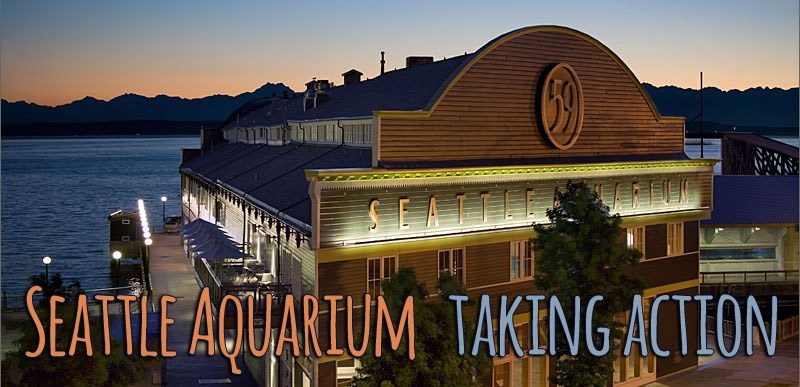
In Part I of our series on conservation asks at World Oceans Day events, we explained the concept of seizing these unique opportunities to encourage your visitors to take environmentally-friendly actions (conservation ‘asks.’) In Part II of the series, we introduced you to how an innovative pilot program at California Academy of Sciences is exploring how to best make conservation ‘asks’ by interpreters through a collaborative professional learning program. In this installment, Part III, we’ll take a look at how Seattle Aquarium has made conservation ‘asks’ an integral part of their World Oceans Day celebrations in 2012 and 2013 – and what they’ve learned from the experience. Seattle Aquarium takes action Seattle Aquarium’s 2012 and 2013 celebrations had a strong conservation orientation – the institution definitely doesn’t shy away from civic engagement. In 2012 they focused on messaging about ocean acidification, marine debris, and MPAs. For 2013 they narrowed the focus more by encouraging action on ocean acidification and marine debris. To help in these efforts, the Seattle Aquarium has turned to their youth advocacy volunteer group, Puget Sound: We Love You. The group has run the ‘Hour for the Ocean’ campaign , leading to hundreds of people in the Seattle area taking one hour on June 8th to do something clean up their local watershed. For 2013 the aquarium experimented taking it to the next level with the ‘Be an Ocean Hero’ campaign. Each station at their World Oceans Day event presented three actions visitors could take to protect the ocean: on an individual, community, and civic level. They supported these recommendations by giving examples of what the aquarium was doing as well. The aquarium implemented consistent messaging on multiple levels: they presented the same action tips in a blog post prior to the event, pushed them out via several social media posts prior and during, and had docents repeat them during interpretation with guests at various stations. Lessons Learned So what did Seattle Aquarium learn from their experience which could help other institutions encourage their visitors to take action for environmental health? Focus on fewer issues. This provides a consistent narrative and doesn’t leave guests overwhelmed. The Seattle Aquarium, for its part, plans to continue to use effective story telling and strategic metaphors to emphasize one or two of the most prominent issues for their local marine environment. Emphasize local impact. A local narrative helps visitors see why the actions - whether individual, community or civic actions - are relevant to them personally, and encourages local pride. It also is much easier for visitors to understand, accept and appreciate than impact on "the ocean." Use animal ambassadors. Visitors care about the animals and want to help. With this in mind, the aquarium incorporated conservation action into their harbor seal presentation. Nicole Killebrew, Marine Science Interpreter shared the following example: “One of our primary themes this year was marine debris. Using our harbor seals as ambassadors for the local wild population, we facilitated a series of enrichment presentations to demonstrate the impact that marine debris has on marine mammals... At the end of the presentation, we received streams of visitors encouraging us to do this type of presentation every day because of the messages’ relevance and importance.” Encourage the sharing of stories. Certain activities can also give visitors a chance to talk to other guests about what they themselves are doing, spreading the knowledge and normalizing ocean protection as a part of responsible citizenship. Nicole recalls: “A guest responded to our ‘Oceans of the World’ activity by sharing their involvement in donating to various organizations that promote coral reef conservation and ocean health...The conversation was rich with ideas about ways people can get involved in supporting grassroots organizations that are making a difference.” Thanks to Nicole Killebrew, Dave Glenn, and Becky Bingham at Seattle Aquarium for their great help, insight, and willingness to share their experiences. If you’d like to share how your institution is inspiring visitors to help the environment, please don’t hesitate to email us.
Continue reading -
Two fish with one hook: Conservation action at World Oceans Day Events
Many zoos, aquariums, and museums (ZAMs) consider inspiring conservation one of their major goals for interacting with their visitors and the public. Recently, many of our partner ZAMs helped their visitors take a first step for ocean conservation by getting them involved at World Oceans Day celebrations. Smart staff "caught two fish with one hook" by explaining to guests how they can adopt long-term environmentally friendly habits, and then supported their sense of personal efficacy and identity as "green" ocean protectors by having them take real conservation action in their communities on that day. It's exciting to see more and more partner ZAMs' commitment to encouraging environmental stewardship among their visitors. Here are a few examples of what our partner ZAMs did for World Oceans Day this year. Plastic bag pollution: Provide a solution Utah’s Hogle Zoo addressed plastic bag pollution by encouraging guests to recycle their trash and stop it at the source. The Zoo kept it local by collaborating with a community recycler, Rocky Mountain Recycling, to collect and recycle plastic bags, and joined forces with a local grocer, Fresh Market, to donate a free reusable bag to guests who brought 10 or more plastic bags to recycle. According to Hogle Zoo’s Events Coordinator, Cagney Smullin, “It was very popular and we had hundreds of plastic bags turned in. We put out messaging and tried to educate guests that it's best not to use plastic bags.” Hogle Zoo was smart about addressing this problem because stopping a harmful behavior (using plastic bags) isn’t enough; it's important to replace it with a positive behavior (using a reusable bag). This successful collaboration informed visitors about the negative effects plastics have on the oceans and its wildlife while providing them with a way to help as part of the solution to this issue. Visitors to Utah’s Hogle Zoo exchange plastic shopping bags for reusable ones. Interactive games for conservation win over kids... and adults Many of our ZAM partners found it helpful to embed information and appeals for environmentally friendly actions into fun activities, which reinforced the environmental conversation message and gave visitors opportunities to practice taking on such actions. For example, at their World Oceans Day event, the Santa Barbara Zoo created a fun, interactive game for visitors to learn more about sustainable seafood. “The fishing game for Seafood Watch, where kids 'fished' out laminated fish and then consulted a large manual to see if they should eat them was really successful… It was very successful to have a game where we could engage people and keep them around longer. Even adults would fish out laminated fish and check to see if they should eat them” explains Ria Boner, Conservation and Research Coordinator at the Santa Barbara Zoo. Visitors also were excited to learn about the Seafood Watch phone application because it “would be harder to lose” than a paper pocket guide. Seafood Watch has a new downloadable app to help users learn up-to-date sustainable seafood info. Coastal cleanups: Threats from marine debris taught through action Around the globe, one of the most popular World Oceans Day activities was a coastal cleanup. Volunteers of all ages helped to clean up their local shores, some collecting hundreds of pounds of trash. This type of event is a great opportunity to teach people about the threats of marine debris, which can be reinforced with first-hand accounts of coastal pollution. The cleanup event held by Museo Sang Bata Sa Negros, an interactive marine museum for children found in Sagay City, Philippines, was particularly exciting. The museum’s director Elizabeth Cordova-laO' explains, “Since our museum is located right beside the sea, during World Oceans Day, we had a coastal cleanup activity with 60 kids participating and some of their parents.” Not only did they hold a cleanup, but they engaged the kids about what they had learned with a lot of fun and excitement: drawing contests, freeing an entangled sea turtle, talking about why their local mangroves were important to their community, a dance performance, and more. Researchers have noted the benefits of volunteering in actions like these, especially with children. Some of the benefits include the potential to promote healthy lifestyles and choices, improve one’s sense of community, and encourage civic responsibility. Coastal Cleanup at Museo Sang bata Sa Negros in Sagay City, Philippines. Look out next week for our next blog posting, which will talk about ZAM partners who asked visitors to make an Ocean Promise in honor of World Oceans Day.
Continue reading -
Weekly Round Up: ecosystems at our service
In the round up this week: ecosystems at our service, bag the nag if you want shoppers to be green, and keeping up with the Joneses lawn. If you’re a science communicator or educator at an informal science center (such as a zoo, aquarium, or museum) trying to encourage conservation action – this is the round up for you! Every week we break down the most interesting recent news and best resources to help you frame the issues as effectively as possible. Ecosystems: at your service! A new study by Stanford researchers published in Nature shows just how important healthy coastal ecosystems - oysters, reefs, swamps, dunes, etc - are to healthy coastal communities. The study mapped existing such systems in the US and found that without them "twice as much coastline and 1.4 million more people will be highly exposed to climate risks." Try using the concept of free ecosystem services (in plain language) to communicate with audiences and visitors about the value of conservation. "Nature" isn't just important to protect because of abstract, distal reasons (it's beautiful! biodiversity!); it has an immediate effect on the health and economies of coastal communities. Putting it in terms of recent events is even more impactful: healthy coastal ecosystems help protect people from extreme weather like Hurricane Sandy, they do it for for free! Oh, behave If you read last week's round up, you know that motivated reasoning can make it hard to get through to people about their beliefs and habits. Here are a few interesting studies that get at why people behave the way they do, and insights for how communicators may be able to nudge them in an eco-friendly direction. Study: Remind people to make green decisions, don't make them feel guilty French and Italian researchers experimented with two community-based social marketing techniques: public declarations and prompts. They asked shoppers entering a supermarket to sign a poster that said “Stop using plastic bags. If I can do it, so can you.” Then - half were forced to admit they sometimes used plastic bags, and the other half were left alone. Researchers then observed how the two groups behaved at the checkout line: people who only signed the poster were more likely to buy a reusable bag (rather than take a free plastic bag) than the people who were forced to admit they sometimes used plastic. The takeaway? Asking someone to make a public pledge or publicly identify themselves as "green" will motivate them to act accordingly - it's uncomfortable to feel like your actions don't match up with your identity. However, if you guilt and nag them about it they might be more likely to rationalize and justify their bad behavior, making them care less about acting green in the future. Study: Homeowners Use Lawn Chemicals Mostly Because Neighbors Do It Ohio Sate University recently investigated why people use chemicals on their lawns - 62% of respondents to their survey said their lawns are important to their "sense of social status and acceptance in their neighborhoods." A quote from one of the researchers: "Based on the study, the main factor influencing a homeowner's decision to use lawn chemicals is whether neighbors or other people in the neighborhood use them," Blaine said. "Homeowners crave acceptance from their neighbors and generally want their lawns to fit in with their surrounding community, so they adopt their neighbors' practices. It's not that they feel pressured to treat their lawns. Rather, they genuinely want to fit in." You don't have to be actively pressured to be motivated to keep up with the Joneses. The study concluded those hoping to encourage responsible environmental lawn care would be more successful targeting their campaigns at neighborhoods rather than individuals. This study is a great example of why it's important to know your audience's motivations when planning a campaign to change behavior.
Continue reading