-
Calling Youth Worldwide to join the World Oceans Day Youth Advisory Council
Apply to join the World Oceans Day Youth Advisory Council! The World Oceans Day Youth Advisory Council (Council) was created in 2016 to help develop World Oceans…
Continue reading -
ISG+ Final Report: Seattle Youth Climate Action Network is Looking Back and Planning Ahead!
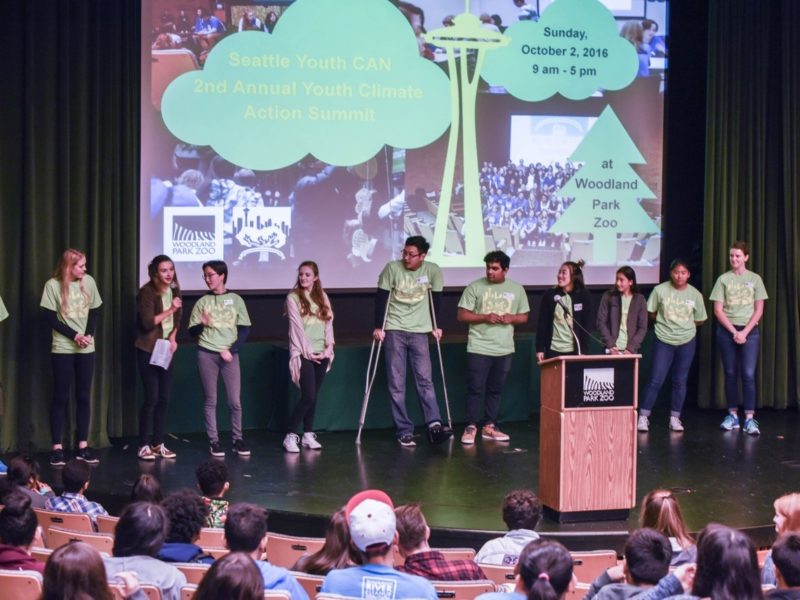
This guest post by Eli Weiss of Woodland Park Zoo is the last in a 3-part series on their Innovative Solutions Grants+ project, exploring how teens in the Seattle area can empower each other and their peers for action on climate change. When the idea of Seattle Youth Climate Action Network was hatched in the fall of 2014, inspired by conversations with teens in Woodland Park Zoo’s ZooCorps program, we were looking for a new approach to engage local youth in the zoo’s mission and connect the dots between “learn…care…act,” and decided to apply one of the major lessons from the research by The Ocean Project: youth already care and want to turn their concern into action! With two years of support from the Innovative Solutions Grants+ Program, hundreds of teens have participated in the project, and together we have developed and tested a pilot campaign while creating and refining an innovative local network approach that has great potential for continued local growth. In fact, our experiment has blossomed into something that our institutions and local community value as a new approach to regional youth climate engagement, and we believe could serve as a model for other regions across the country! As mentioned in our last post, our goals for this past year have been to: Expand the networks reach locally through outreach and more inclusive programing, and Build on our initial successes with the Summer Transportation Challenge and Youth Climate Action Summit. Let me reflect on our successes and lessons learned for each of these goals as we wrap up our work under this grant. Growing the Network Face of Climate Action We have seen great interest in Seattle Youth CAN, and under this grant cycle alone more than 400 teens have signed up to get network updates and over 200 youth have attended one or more events since January 2016. For us this has been a great sign that there is a growing interest in Seattle Youth CAN among local teens. While some have heard about the network from peers or through other direct outreach efforts with which we have experimented, including tabling at events and broader social media presence including facebook, instagram, and twitter (See also our last post), our most successful approach was to identify and work with other youth programs where we had overlapping interests. Echoing a finding from our ISG+ peers at the National Aquarium, we learned that these relationships take time, but they are well worth the effort. We have been working with a range of community groups and agencies, many of who are eager to deepen our partnership through this project. For some groups there was immediate interest, while others took time to find the right opportunity for collaboration. An example of the latter is the Duwamish Valley Youth Corps, an environmental youth development program in SW Seattle that we have been encouraging to join the network since our 2015 summit. This year, we had more than 20 of their youth attend our summit! Another relationship that we are excited about is with the University of Washington College of the Environment, a partnership that came about because our youth have expressed interest in increasing our focus on exploring climate related career pathways, so this past summer we co-hosted a college career panel at the UW that was attended by 50 teens and the College in turn also participated in our recent Summit. Our advice to other zoos and aquariums? Take the time to develop relationships with other organizations who have an overlapping interest in reaching youth and advancing conservation rather than doing it alone. An Ongoing Commitment to Youth Leadership The creation of a Youth Leadership Committee, made up of teen leads from the zoo, aquarium, and science center - has worked out especially well. The Committee helps to make significant decisions about the direction of the project and the focus of action campaigns and events this past year. We feel confident that Seattle Youth CAN’s current direction reflects the needs and interests of Seattle-area youth. Since our launch, we have looked to our youth leaders to make major decisions impacting the focus of the network including: types of projects, the design and focus of action campaigns, and how we communicate with teens in the network. In turning over decision making to our youth leaders, we have learned that there is a fine balance between supporting youth driven ideas and having the capacity to help them be successful in their plans as I’ll describe below. Our advice to others? Empowering youth leaders to develop public, and especially peer-to-peer, conservation engagement efforts is highly recommended and can lead to exciting new engagement strategies! Youth leaders Lessons from the Transportation Challenge 2.0 For the 2016 Summer Transportation Challenge, we let our youth leaders develop the plan, which included an ambitious, and, in hindsight, overly ambitious, eight-week campaign with weekly events and social media challenges aimed at engaging other teens in fun activities and events that helped increase personal action and carbon reducing transportation choices. It all seemed great when our youth leaders formed their plans in the spring, but by mid-summer we realized that many of them didn’t have as much time as we anticipated amidst busy summer obligations to fully support the challenge. This meant that our staff were tasked with carrying out much of what was set in motion by our youth leaders. We were expecting that an increase in the frequency of events and the length of the challenge as compared to last year would lead to many more teens getting involved. The challenge ended up with some bright spots but fell short of those expectations. The biggest bright spots were that the challenge had a positive impact on participants (See for example Masayuki’s blog post) and the environment, with more than 90 teens attending summer events and challenge participants logging 7,513 miles of not driven alone, which equals 3,214 pounds of CO2 saved. In addition, the continued transportation focus allowed us to expand on our partnership with a key partner, King County Metro Transit, and our teen leaders worked with the agency to develop messaging, including this video, to encourage youth to utilize public transit and make the connection between riding the bus and fighting climate change. As for what didn’t work, we learned that having events during the week made it hard for some teens to attend given other obligations. We were also surprised that the weekly social media contests did not lead to more participation, and how some teens in the network, even though they had developed the ideas, were not interested in posting challenge related things on their own social media channels. Lastly, we are rethinking the timing of the transportation challenge in our calendar of events, and our teen leaders are already talking about focusing on the school year, rather than the summer, in 2017, when student schedules are more predictable. And, of course, we learned that with limited time and resources, we realized the need to either limit plans or add staff to support the ambition and growth of our youth leadership and the action campaigns and events that they develop. Our advice to others? We learned that when teen leaders are developing public engagement efforts, their enthusiasm and ideas need focus to ensure successful implementation Summit Success On October 2, Woodland Park Zoo hosted the 2nd Annual Youth Climate Action Summit and brought together 100 Seattle-area teens interested in fighting climate change and more than 20 climate focused community leaders. This culminating full day event was organized and led by eleven youth leaders and Woodland Park Zoo staff. And learning one of our own lessons from the Transportation Challenge, we were sure to create clear and realistic expectations for youth leadership, which lead to an event that maintained a very youth driven feel, while having enough staff support to make it all come together and run smoothly. Youth leaders on stage Youth who participated in the dynamic day of learning and action attend 39 local schools and a range of youth programs, and for 70% of attendees it was their first Seattle Youth CAN event. Having such a diverse group of youth in attendance was a direct result of both peer to peer outreach and, in particular, our newly formed partnerships with other local environmentally focused youth programs including those already mentioned above as well as Seward Park Audubon Center and YMCA Earth Service Corps. Over the past year, we have seen Seattle Youth CAN expand from the original participants, teens already involved in programs at the zoo, aquarium, and science center, to a much broader group of youth leaders who were not already connected to one of these three institutions. This growth is exciting and through our ongoing refinement of the network we believe that the number of youth leaders participating will continue to increase in years to come. Another indicator of success for the summit and other events is that teens are having a good time and building community. Read, for example, Katherine’s recent blog post on how Seattle Youth CAN is creating a positive and fun space for teens to take climate action. An “Action Fair" was a new addition to summit this year worth mentioning, which crated a dynamic forum for youth participants and climate focused community groups to dialogue though activities at an outdoor tabling event. Participating groups included University of Washington, Earth Games, Carbon Washington, Sierra Club, Solar Washington, Plant for the Planet, Our Children’s Trust, and 350.org Seattle. For many of these groups it was the first opportunity to interact with teens from Seattle Youth CAN and we have already begun exploring how we can work more closely with some of them in 2017. Check out the full schedule for more details on workshops, presenters, and participating community groups. Our advice to others? Zoos and aquariums can play a critical role in developing networks of youth conservation leaders, and in this electronic age don’t underestimate the power of in-person gatherings Measuring our Impact We hoped that teens who participated in Seattle Youth CAN this past year would not only (1) Increase their understanding of the issue, but (2) increase participation in actions to fight climate change, and (3) that youth leaders would develop measurable leadership skills. Although our audience research team is still hard at work evaluating results from our 2016 programs, we have seen positive trends from an initial review of pre and post survey results and participant interviews to feel confident that Seattle Youth CAN is having a positive impact in these three areas. Stay tuned for a follow up report in late 2016. Making the mountain Group with mountain Next Steps In 2017, we are planning to form a Community Advisory Committee to ensure that we have broad support and diverse input from all of the community collaborators with whom we’ve connected over the past two years. To help with youth leadership, we are planning to add a paid youth climate fellowship opportunity, to build on the youth driven spirit of the project. Also, in an effort to help reach all youth in our region, we plan to conduct focus groups this winter with teens throughout the metropolitan area. We are grateful for the past two years of funding from The Ocean Project’s Innovative Solutions Grants+ program, as it has allowed us to pilot this new model for local youth climate networks. We have truly valued the ongoing support and coaching from The Ocean Project’s staff and have also appreciated connecting with other recipients of the ISG+ program. We are committed to the future evolution of this work and are excited to continue to share what we’ve learned with other institutions and communities across the countries who are interested in launching their own network or youth climate action project. If you would like to explore the idea of starting a youth climate action network in your region or are already working on a youth climate project and want to connect, please get in touch! Seattleyouthcan@zoo.org
Continue reading -
Tell a local story
The average person has 50,000 – 70,000 thoughts every single day. That’s a LOT of ideas to be sorted and dealt with! Considering the mental maelstrom, how can we make the complex threat of climate change seem worth not only thinking about, but possibly making major life changes to address? One reason climate change is so hard to act on is our psychological distance from it. The harm from climate change seems to be physically distant from us, far off in the future, and happening to other people. These factors make climate action seem a lot less important than the many other concerns constantly fighting for our attention all day long. For more on bringing climate closer-to-home, check out Connecting on Climate: A Guide to Effective Climate Change Communication guide. The guide covers a variety of great topics, insights on making the local connection start on page 29. It’s extremely important to close this psychological distance for your audience so that they can give climate action the attention it deserves. This is a cross-post from ClimateInterpreter.org. Please visit for more resources and articles about communicating climate change for interpreters! Pair close-to-home examples with big-picture concepts The reality is that climate change is already causing harm, right here and now. A great way to make climate change real and relevant to a person is to directly connect it to their everyday life. For example: the concept of sea level rise is much more impactful when supported with a local story about the real-world harm it causes to people like those in your audience. The less abstract the threat is, the more engaged people will be with being part of the solution. Be sure to highlight the solutions to the problem to avoid making people feel overwhelmed or hopeless – heightened engagement with a scary threat can actually cause people to give up instead of take action if they see the problem as insurmountable. Finding your community’s story There are some great resources online for finding ways to tell your community’s story. Using search engines is a good way to start – you can google “environmental problems in (your city or state)” and follow links to local non-profits for more information. You can also check out some of these specific resources for leads on story ideas MyEnvironment - enter your location and get access to several EPA databases to provide you with information about environmental activities that may affect air, water, and land anywhere in the United States Coming Clean: The State of US Renewable energy – see how your state is doing on renewable energy State and local climate adaptation – see what your state is doing to adapt to climate change. There is some disagreement on this depending on source: see the Center for Climate and Energy Solutions map and/or Georgetown Climate Center’s map and info. GlobalChange.gov – the US government has a new website on how different US regions are impacted by climate change based on the Third National Climate Assessment. Explore the their interactive map or see your region’s highlights. Next: some ways to incorporate these stories into interpretation. This is the first part in a 3-part miniseries about “small” stories for big impact: Tell a “wildly” emotional story; Tell a local story; Tell YOUR story
Continue reading -
Poll: Red or blue, regulate CO2
Results from a national survey conducted in late 2013, and made public yesterday by the Yale Project on Climate Change Communication and the George Mason Center for Climate Change research, show strong support for action among Americans of every political orientation. A whopping 83% of Americans say "the U.S. should make an effort to reduce global warming, even if it has economic costs." In a sign of hope for generating the political will to do what needs to be done to ensure a healthier climate and ocean, and a sustainable society for the future, majorities of both Democrats and Republicans support national action on climate and energy policies. Majorities of Americans in red, blue, and purple states support: providing tax rebates on the purchase of energy efficient vehicles or solar panels; funding more research into renewable energy sources; regulating CO2 as a pollutant; and eliminating all subsidies for the fossil fuel industry. From ClimateProgress: "In general, Americans want less fossil fuels and more low-carbon energy — with many willing to pay more for those benefits: 67% want to regulate carbon dioxide as a pollutant 59% want to cut fossil fuel subsidies entirely — while 60 percent think cutting renewable subsidies is a bad idea 56% would pay an extra $100 a year if it meant their electric utility was required to produce more than 20 percent electricity from renewables 72% want more research funding for renewable energy" For the complete study, "Public Support for Climate and Energy Policies in November 2013," please link here. Also, stay tuned as we will soon be releasing action guides, specifically to help our partner network effectively engage their visitors and the public in helping with solutions to climate change and ocean acidification through green power opportunities around World Oceans Day.
Continue reading -
Aquarium of the Bay: reframing climate change for action
In part 2 of our blog series on past Small Grants projects at zoos and aquariums, Quinn White of Aquarium of the Bay shares what they've learned about making climate change personal, and asking visitors to take action. Background and summary of project Aquarium of the Bay strives to improve the future of San Francisco Bay and its watershed by engaging a new generation of stewards and advancing real solutions for a healthier habitat. We reach a broad audience of residents as well as visitors from all over the world. Our goal was to help these guests commit to addressing climate change on a personal level. Updates on project Thanks to support from The Ocean Project, the Aquarium successfully trained our staff to frame climate change in a way that helps guests understand climate change and its impact on their own lives. Previous experiences frame how people see the world, so two people can look at a prop or an animal and understand it in two completely different ways. By connecting guests’ personal experiences to the topic at hand, we can expand their frame of reference to help them understand the problem of climate change—and its solutions. In addition to our improved messaging, we added an environmental action dimension to visitors’ experiences. Our Climate Change Action cards reinforce messages about taking local action, so Aquarium visitors understand specific ways they can personally make a difference in their own backyard. These tools have been combined to update all five of our climate change-focused daily visitor presentations. Our animal ambassadors and their associated call to action have successfully turned a moment of inspiration into an opportunity for visitors to make lifelong changes that lessen their environmental impact. We took our message online as well—you can find our climate action cards on our website. The online component was inspired by The Ocean Project’s recent research on the importance of online education. Our website now shares these printable cards as well as stories that highlight what our staff is doing to reduce their own carbon footprints. Lessons Learned The responses we’ve received regarding the updated visitor presentations from staff and guests have been very positive. Staff report that it is easier to talk to guests with a more hopeful message and it is easier to have a conversation when connecting to their universal values. The stay time for guests has also increased; in the past, guests would listen for a few minutes and then leave; now they stick around for the entire presentation. Guests are also more engaged and asking more questions, and the presentations have turned into productive conversations, sparking curiosity and inspiring further action. After learning about framing and universal messaging, one staff member said “Frankly, I’m blown away.” He mentioned that he had heard about universal framing but had never realized its effectiveness until the training. Staff have noticed that children especially are more excited when they participate in the visitor presentations. For example, in our ocean acidification presentation, children are excited to learn more about ocean chemistry and why it’s important to keep the ocean’s water healthy. Also, in our solar and wind power presentations where we focus on innovation for alternative energy, visitors leave inspired and children want to learn more so that when they grow up they can help innovate other forms of energy. In regards to putting their training into practice, staff often responded by simply saying, “It really works!” The training also resonated with staff by identifying ways to front load key messages. In other words, putting the conservation message at the beginning of the presentation grabs the audience’s attention and helps them be more invested in the issue. - Quinn White, Development Manager and Grant Writer at Aquarium of the Bay
Continue reading -
Round-Up: Grassy lawns are SO out, Solar is SO in
In this week’s round-up: climate change’s impact on marine…
Continue reading -
Weekly Round Up: Bringing morals and human rights into the picture
In the round up this week: Moral arguments sway public opinions, bringing human rights into the story to make a big impact, and polls reveal shifting political views of Americans. If you’re a science communicator or educator at an informal science center (such as a zoo, aquarium, or museum) trying to encourage conservation action – this is the round up for you! Every week we break down the most interesting recent news and best resources to help you frame the issues as effectively as possible. Use Moral Argument to Sway Public Opinion Human rights + ecological controversy = impactful story Climate change in politics: Let the polls speak for themselves More useful resources Climate action: it's not just rational, it's ethical As we’ve discussed in previous blog posts, there are many factors that influence one’s opinion about climate change. There is mounting evidence that making a moral argument in favor of acting to slow and mitigate climate change is one of the most effective strategies to make a lasting impact on public opinion. This summer’s Environmental Polling Trends report, released by ecoAmerica, supports that opinions are swaying, showing that most US citizens are concerned about climate change and they want to prepare for the impacts of climate change. Another major finding from this poll is that moral arguments seem to have the most support (93%) in swaying public opinion. Though, one blogger for The Guardian Professional points out the moral arguments are missing from the behavior change debates. The Guardian’s Adam Corner writes, “Ultimately, it is morals and values, not facts and figures, that inspire public support for policies, and transformative behavioral changes will not follow from superficial methods of engagement.” Corner suggests that we concentrate on “re-connecting with a straight¬for¬ward idea: that morally, confronting climate change is simply the right thing to do.” Human rights + ecological controversy = impactful story Here’s a framing tip: if it’s bad for the animals and it’s bad for humans, the story is sure to make an impact. The palm oil industry has been contributing to documented habitat devastation for animals such as the orangutans for years, but we are also learning about the not-so-well-documented human-rights abuses of the industry. The shared plight of orangutans and people make this story hard to ignore. Climate change in politics: Let the polls speak for themselves Public opinion about climate change in America has a history of changing like the weather, but it looks like the winds might be shifting in favor of action. In the United States, a nationwide poll shows that the majority supports President Obama’s new plan to address climate change and cut carbon emissions in the US. It looks like young voters are not only in support of Obama’s plan, but would oppose members of Congress who stood in the way of the president’s climate action plan. According to a poll of US voters under age 35, it is widely believed that “denying climate change signals a much broader failure of values and leadership,” noted in the polling memo. Many young voters (including young Republicans) would write climate misinforming candidates off completely, with 37 percent describing climate change deniers as "ignorant," 29 percent as "out of touch" and 7 percent simply as "crazy. More useful resources Do you live in one of these states: Arizona, California, Colorado, Delaware, Hawaii, Maryland, Massachusetts, Nevada, New Jersey, New Mexico, North Carolina, and Vermont? Environment America has deemed them the “Dazzling Dozen,” with the highest per capita solar electricity capacity in U.S. Be sure to share success stories like this with visitors to show them what’s being done in their community, and how it’s good for the environment and people. For those other 38 states catching up in the renewable energy boom, it may help to show others why clean energy is such a great investment; wind and solar can prevent more pollution and actually save lives.
Continue reading -
Weekly Comm. Round Up: cheap coal causes pricey illness
Happy International Women’s Day! This week we have articles about…
Continue reading


