-
Building Mutually Beneficial Relationships with Elected Officials
To help you better understand the public policy space and what role aquariums and zoos can play at the comfort level that works for you, The Ocean Project is…
Continue reading -
Nothing fishy about engaging visitors on fisheries issues
In his recent post The Ocean Project’s policy advisor, Tom Adams, underscored the importance of protecting the policies that protect our ocean, and referred to the need for…
Continue reading -
Saving Energy to Save Wildlife
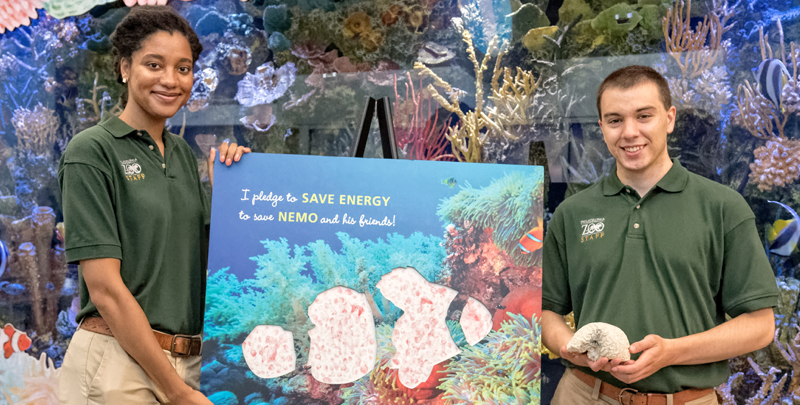
The recruitment phase of the Philadelphia Zoo’s “Saving Energy to Save Wildlife” project concluded at the end of 2016 with impressive results. Drawing from…
Continue reading -
Collaborating for Conservation in 2018
Happy holiday season! Thank you to all the organizations from around the world that are involved in our partner network and working to advance conservation….
Continue reading -
Communicating Conservation Effectively with Zoo and Aquarium Guests
Conservation is the action of protecting and rejuvenating ecosystems so that the plants and animals within them can thrive indefinitely. If those inhabitants could accomplish this on their own,…
Continue reading -
The Ocean Project launches new initiative to promote science-based federal fisheries policy and healthy, sustainable marine ecosystems
Healthy and productive marine ecosystems are critical to sustaining food, jobs, and recreation for millions of people, as well as producing other intrinsic quality of life benefits. To have…
Continue reading -
ISG+ Final Report: Philadelphia Zoo visitors say an overwhelming yes to “Saving Energy to Save Wildlife!”
After almost a year of testing and active recruitment for our study, we’ve been learning a lot about how to engage visitors on the issue of Saving Energy to Save Wildlife! We have been humbled by our visitor's trust in us and wowed by their willingness to pledge to reduce their household energy use. Last year, with the generous grant from The Ocean Project, we set out to test whether onsite messaging can affect offsite behavioral change. Using NNOCCI (National Network of Ocean and Climate Change Interpretation) framing methods, we constructed a short activity that invites our visitor to learn about ocean acidification. The message and activity were constructed to engage intergenerational audiences – the children and their adult chaperones. As one interpreter engages with the child through play and pledging, the other interpreter speaks to the adult about ocean acidification and participating in our study to measure their household energy usage. If they are PECO customers, they sign a consent form allowing us to track their energy usage for a year. While circumstances outside of our control (e.g. finessing legal details, losing our contact person) have stretched out the project for longer than the original 12-months – and we are still waiting on final numbers – we are going to share some thoughts and onsite results if you should consider doing the same project at your institution. 1. High interest in opportunity to act As indicated in our last blog, our pledging (to reduce household energy consumption) rate was high, especially after we adapted our approach to foreground the “ask” and add a second staffer so one could engage the younger audience while the other recruited the adults (parents/guardians). While visitors are easily distracted by the charismatic animals that are all around us, those who remained were very likely to have someone in their group pledge their commitment to taking conservation action at home. Approximately 3 of every 4 groups who engaged with our staff were willing to pledge! Moreover, we found that visitors reacted very positively, and were pleased at the opportunity to participate. and few of them balked at the ask, which brings us to the next point… Our advice to other zoos and aquariums: If you’re worried about asking your visitors to take conservation action, don’t. As The Ocean Project and so many other studies have consistently provided clear evidence for, visitors DO NOT consider it a chore that you are asking them to take conservation action. 2. Zoo visitors are willing to back up their pledge In addition to pledging to take action, 54.3% of those who were asked to participate in the tracking study responded positively. This was a very pleasant surprise for us as we were not sure how willing zoo visitors would be to let us track their household energy usage. More than half of our visitors were willing to let us study the trend in their energy consumption. While there were some visitors who did ask our researchers for clarification, most of our visitors were ready and willing to participate. Figure 1: More than half of our intergenerational groups (consisting of at least one adult and a child) were willing to participate in the study Our advice to other zoos and aquariums: What has become clear for us as a result of this study (which is consistent with feedback we are receiving from other sources) is that our visitors want to do more. Oblige them. We were terrified that asking people for permission to track their household energy use would be too audacious, but the overall response has been positive. Trust that your visitors are ready to do even more than you suspect. 3. Biggest barrier to non-participation: different service providers Of the visitors who were interested in participating for the study, almost half (44.8%) were not eligible because they were not PECO customers. We collected a list of 17 service providers, but 4 primary providers – PSE&G, PPL, DelMarVa, and Atlantic City Electric – serviced almost three-quarters (74.4%) of our other interested (but not eligible) participants. We have always known that our visitors are diverse and come from the tri-state area, but now we know that they are also diverse in their electricity companies! This does suggest that a study such as this would work really well for an organization that has fewer providers in their market area. Figure 2: Almost as many people were interested in participating but were not eligible (not PECO consumers) Our advice to other zoos and aquariums: How many energy providers are there in your region? In the Philadelphia area, there were many providers by choice and by zipcode. To have a higher overall recruitment rate, you might want to consider setting up partnerships with the biggest providers in your region. If we had increased our partnership from 1 to 4, we could have doubled our number of participants. The greatest barrier to participation is not visitor interest but our lack of ability to support their interest. 4. Intensive project Throughout the six months, we engaged more than 1500 visitor groups to KidZooU’s coral reef tank. Of the 1327 groups with at least one adult that we spoke to, we had the opportunity to ask 641 (48.3%) of them if they were interested in participating project. Of those 641 groups, 348 (54.3%) said they were interested, and 293 (45.7%) were not interested. Our advice to other zoos and aquariums: This situation could be improved by addressing the number of providers you partner with, but there is no denying that this (at least in its current form) is a highly intensive project. But take the lessons that we have learnt and build on it instead of starting from scratch – such a preponderance of evidence already exists that our visitors want to take conservation action, we don’t need prove that repeatedly. If you should take on such a project, make sure to provide adequate support for your staff – it is a highly repetitive and tiring process for them. Have them out for short (1-2 hours) shifts; intersperse their sessions with other projects to provide variety; provide them with tasks that have more immediate positive feedback to keep their energy up. Conclusion Despite the intensive and tiring process, we are extremely glad we took on this project. We are glad that The Ocean Project’s Innovative Solutions Grants+ provided us with the opportunity to clearly demonstrate that our visitors are ready for bigger asks. Much bigger. As a result of this study, the Philadelphia Zoo is now examining the opportunities to expand this to other parts of our institution, focusing on scaling and learning how to deepen the impact. This framework and approach will be incorporated into our institutional operations. And now that we know our visitors are ready and willing to do what it takes to make a significant difference for wildlife, we are excited to embark on the next stage of the journey. Our take home message? Ask early and ask BIG. Don’t be shy.
Continue reading -
The Houston Zoo Explores Whether Artistic Displays Inspire Conservation Action!
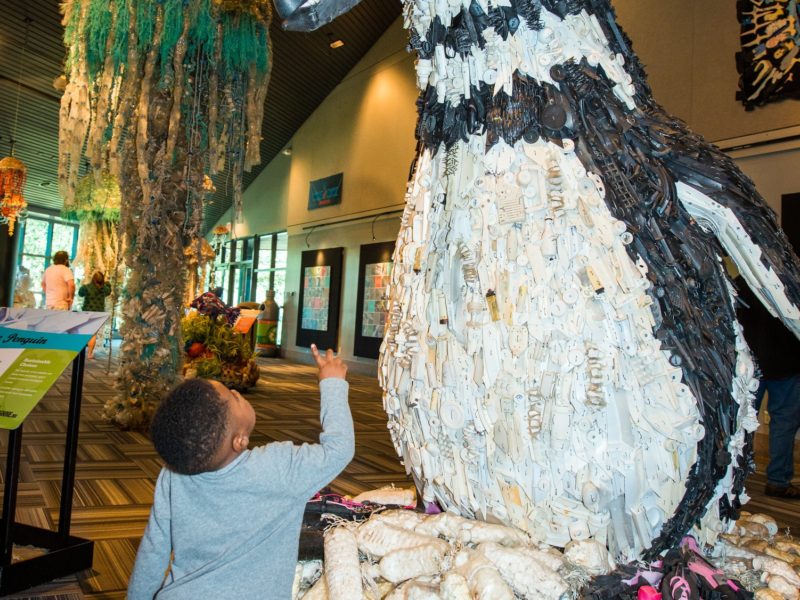
This guest post is by Martha Parker, Conservation Impact Manager at The Houston Zoo. The Houston Zoo is committed to saving wildlife through partnerships and the support of global and local conservation projects, while connecting the Houston community to wildlife at the Zoo and inspiring them to action. To help fulfill our goal of saving wildlife, the Houston Zoo has been addressing the issue of plastic pollution. We went plastic bag free in July 2015, a decision that helped reinforce our commitment to reducing plastic pollution, a major threat for marine wildlife like sea turtles, which we work diligently to protect. The Houston Zoo receives wild sea turtles who require medical care and rehabilitation support from our partners at NOAA. Some of these turtles arrive at the Houston Zoo because they have ingested plastics or are entangled in marine debris. This makes the connection between the wildlife we work to protect and the threat of marine debris quite clear for us. The Approach To further our protection efforts of local sea turtles and help connect our community to the threat of marine debris and how they could take action, we welcomed Washed Ashore to the Zoo in January of 2016. Displayed at the Zoo’s Brown Education Center, Washed Ashore was the perfect visual representation of a global issue that hits home for Houstonians living so close to the Gulf of Mexico: plastic pollution. This awe-inspiring exhibit brings to life an overwhelming problem and puts it right in front of your eyes, connecting visitors with the animals affected by trash in our oceans. The Houston Zoo not only wanted to provide a fun experience for their guests, but also wanted to inspire action to save animals in the wild with a very specific ask of going single-use plastic bag free when shopping. After some brainstorming for a fun, interactive guest experience that incorporated data collection, Zoo staff decided the best way to get guests to take a pledge to use reusable bags was to have them add their fingerprint to another artistic display, an underwater-themed mural, designed and painted by famous Houston street artist, Gonzo247. Before participating, however, guests took a short survey and committed to going plastic bag free for three months. Between January and April 2016, colorful sea turtles, sharks, rays, shore birds, and fish were filled in as 1,482 guests took the pledge and showed their commitment by adding their thumbprint to the mural wall, in the animal they were helping to protect by going plastic bag free. This challenge is important to the Zoo’s mission of saving animals in the wild and inspiring behavior change by empowering Houstonians to make a difference. But how do we know if it worked? The Results With our evaluation methods, we aimed to answer the question; do visitors to the Washed Ashore exhibit at the Houston Zoo become inspired to use reusable bags more frequently than those zoo visitors who did not? We asked visitors from both a control group and an intervention group to take the challenge to go plastic bag free for 3 months to save wildlife like sea turtles. The control group was asked this question at the sea lion exhibit before Washed Ashore opened. The intervention group included those zoo visitors who visited the Washed Ashore exhibit. Three months from the time the visitor signed up to go plastic bag free, the Houston Zoo followed up with them by email to see how they did with the challenge. In total, we had 68 participants in our control group, with only 6% responding to the 3-month follow up. Our intervention group included 1,482 participants, and we had a notably better 16% response rate, with 230 of those responded to the 3-month follow up. While the better response rate was a good indication of a positive impact from the exhibit, we did not have enough participants in our control group to answer our original research question. We did gather valuable data that we can use to influence future exhibits and messaging. For example, we confirmed that in keeping with research by The Ocean Project and others, our guests are indeed motivated to make changes in their behaviors to protect animals, and their visit to the Zoo was an important aspect of taking action. Specific to using reusable bags, we know that our messaging should include ways to remember your bags, including tips on keeping them in your car. Finally, it was a great learning experience for the Zoo to evaluate (on a small scale), the impact of our work to save wildlife by empowering our community to take action. What enabled us to be successful in our effort to connect guests to the issue of marine debris and move them to action was the collaboration across numerous departments of the Zoo, and the strong tie between the exhibit and our efforts to save ocean animals like sea turtles, locally. This project has certainly influenced the way we think and plan for future exhibits and experiences. Our advice to others…... Start planning early. Get all relevant departments/people involved so that you choose the correct exhibit for your audience. Develop an institutional goal. No matter the exhibit content, you should have an institutional goal for that exhibit determined so that planning and evaluations can take that goal into consideration. Revisit the exhibit/process at regular intervals. Avoid implementing a project and then when finished, evaluating how it went. Bring all stakeholders together frequently to see how the project is going and make changes as you go. Align messaging/content with what is relevant for your institution, your audience, and the work you do. Communicate with other organizations who have experience with the content/exhibit-find out what worked for them, what didn’t. Track your success-even seeing what didn’t work is critical information to move forward in the future Additional Data Responses from both groups in 3-month follow-up included some positive indications that we were helping to increase bag use: 43.35% of respondents used their bags “almost every time they shopped” during the 3-month challenge, compared to 16.31% of respondents used their bags “every time they shopped” during the 3-month challenge, and only 2.58% of respondents “never” used their bags when they shopped during the 3-month challenge More than 60% of survey respondents put their likelihood of continuing to use reusable bags at “extremely likely” 198 respondents have encouraged family/friends to go plastic bag free as a result of their participation in the challenge, reaching an additional ~1,379 people. It was important for the Zoo to understand the motivations behind why our guests were successful in the reusable bag challenge. We found that motivations for continuing to use reusable bags during 3-month challenge included the following: Visiting the Zoo increased knowledge of how plastic bags are a problem for wildlife was cited by more than 52% of survey respondents. “That exhibit at the zoo really did change things for me. Not just about plastic bags. I have tried to buy less plastic in general - kids dishes and bowls (switched to bamboo), kids toys (wood, fabric, handmade), and I've tried to avoid buying food that comes with a lot of extra packaging. I loved that exhibit because it shocked me to see all of the toys and bottles and things that don't just disappear, thank you for teaching me that I'm contributing even if I think I'm not!” “I have used reusable bags for many years. Mostly at the grocery store. The positive thing in my life about the challenge was not taking bags at other stores such as clothing or craft stores. Taking the challenge actually made me take my reusable bag to the next level, which is to use them everywhere including on trips.” In order to make the Zoo’s messaging more effective in the future, we also asked respondents about barriers, which included remembering their bags. 80% of respondents remembered their reusable bags by keeping them in their car. In the future, we can utilize this information to remove barriers for guests when we ask them to switch to reusable bags. (E.g. “If I forgot my bags at home, I would ask for paper, which got reused. If I forgot my bags in the car, I would just ask them not to bag my groceries and then would cart them out and put them in the bags once I got to the car. It really helped me remember to take them out of the car when I had to do this!”) Additional feedback from Houston Zoo participants: ~Great program to encourage less plastic bag use, thank you! ~I have been using only recyclable bags, mostly fabric, for more than 5 years. I was happy to see the bag challenge at the zoo! I hope you have had an excellent response from others. ~I tell the store clerks about our pledge with the zoo and encourage family to think about using reusable bags. ~The bag challenge did not work for me. I chose to reduce my use of disposable plastic bottles instead. I now have a metal water bottle and have encouraged my children to use reusable water bottles also. ~Great program. The education by the zoo raises our awareness to the damage of plastic bags. Continued education and awareness remind us and help us change our ways permanently. Thank you for all of your hard work! ~This was not easy at first! A few times I forgot my bags in the car and had to take a full cart of groceries out to the car and load them in my reusable bags in the parking lot. Ha! But it was worth it, to know that I helped. Thank you for the challenge! ~This survey is a test reminder to get back on track with using reusable bags! ~Going shopping with reusable bags is fun and fashionable. I use them where ever I shop or visit! The zoo bags are the best. I have 3 of them so far. Please design more! ~I now also recycle all my paper and plastics. Thanks to my Houston zoo visit. Was very impressed with your plastic artwork. ~I have shared this incentive through Facebook by posting photos of the zoo's exhibit and the impact on not only sea turtles, but other sea creatures as well. When I use plastic bags, I always bring them back for recycling, and never throw them in the trash. The exhibit at Houston Zoo changed my behavior absolutely, I had no idea the impact of such a simple, daily use item on wildlife. Thank you! ~It was a great experience and if it had not been for that visit at the Zoo with my grandson, I would still be using plastic bags. Now I find that it is actually so much more efficient to use my own reusable bags, because more items fit into the bag, or maybe the store packers put more into one bag. Therefore, it is also more convenient to carry it into the house. Helping to save the environment is great. Keep up with such programs. Thanks. ~I often forgot my reusable bag but I would still carry out the items rather than asking for a plastic bag. When questioned or given that unsure look by my cashier, I often responded with "I'm plastic bag free, save a sea turtle". At least twice I was asked what I meant and was able to have a short but great conversation about the subject.
Continue reading -

The results are in! SEA LIFE Trust and SEA LIFE Aquariums vote for Marine Protected Areas
Based on a successful pilot, the SEA LIFE Trust and SEA LIFE Aquariums in partnership with The Ocean Project rolled out an effort to engage visitors at all of our American aquariums on the issue of marine protected areas. The pilot gave us confidence! It confirmed that our visitors expect, trust and appreciate information from aquariums about how to help the ocean and its animals, and that they especially liked the opportunity to “vote” in favor of expanding our nation’s network of marine protected areas. Marine Protected Area Ballot The pilot identified an opportunity. We realized that by engaging our visitors and documenting their opinions on this issue, we could give every-day Americans a voice in a discussion that otherwise might be dominated by special interests. This was a role that among all the conservation organizations working on this issue, we were best equipped to do. So we took our initial idea as piloted, and revised it slightly. Rather than asking our visitors a simple yes/no question about their support for marine protected areas, we asked them to choose among four sites we knew to be currently under consideration, while also providing an opportunity to answer with all or none of the above. And we developed a web site to reach those beyond our gates: Our Blue Backyard. Thank you President Obama! Our eight sites collected nearly 30,000 votes in six weeks and diligently counted them all! Yet again our visitors showed that they were strongly supportive of expanding our nation’s network of marine protected areas, with 97% voting in favor of adding one or more sites, and “all of the above” receiving the highest number of votes. And while we did not do another set of exit surveys, the anecdotal feedback from the visitors was also overwhelmingly positive. Most important, we were able to share these views with national leaders at a critical time, right as President Obama was deciding to expand the Papahānaumokuākea Marine National Monument off the coast of Hawaii, and create the Northeast Canyons and Seamounts Marine National Monument. If you would have told me just a few months ago that by the end of our effort two of the four areas would be protected, I’m not sure I would have believed it, but yet that is exactly what happened! We were able to thank our visitors for joining us in support, and then on behalf of our visitors reach out to thank the President. Engaging our visitors, asking them to participate, and documenting their opinons is certainly an approach that worked well! We also, however, learned some valuable lessons along the way about how best to do so. We were reminded of the power of the on-site visit, and the way that inspires guests to want to help animals. We just need to provide them with an easy way to turn that inspiration into action! We saw the benefits of having a relatively simple and straightforward engagement strategy best exemplified by the initial yes/no voting exercise. While some of our visitors wanted to know more about the specific sites being considered, many more simply wanted to express their support for conservation. While many of us “old timers” at aquariums and zoos think about our impact on the indiviudual visitor, we found here a great example of what can be done when taking a more systemic view about how we could help bring the collective opinion of our vistiors to the attention of our national leaders. And we noted that it was best to be flexible in our approaches. For example, we began thinking it would be more efficient and effective to engage guests at ticketing, but most of our aquariums, including the one with the best results (SEA LIFE Arizona Aquairum) found that it was far better to create a separate space. Although it would have required additonal effort, looking back it would have been nice to have done the exit surveys not just for the pilot but for the full campaign, as those exit surveys so strongly suggested that by engaging visitors and aksing them to participate, we also helped increase their sense that together we can solve these problems, as well as their understanding of the improtant role aquariums and zoos can play in advancing conservation. The biggest takeaway of all was that we can, and in my view should be doing more together with our visitors to help advance conservation – it truly is a win-win. And with that, I am already excited about our next effort. This guest post was submitted by Chris Andrews, Head of Animal Welfare and Development at SEA LIFE Aquariums in the US.
Continue reading