-
Saving Energy to Save Wildlife
The recruitment phase of the Philadelphia Zoo’s “Saving Energy to Save Wildlife” project concluded at the end of 2016 with impressive results. Drawing from…
Continue reading -
ISG+ Final Report: Philadelphia Zoo visitors say an overwhelming yes to “Saving Energy to Save Wildlife!”
After almost a year of testing and active recruitment for our study, we’ve been learning a lot about how to engage visitors on the issue of Saving Energy to Save Wildlife! We have been humbled by our visitor's trust in us and wowed by their willingness to pledge to reduce their household energy use. Last year, with the generous grant from The Ocean Project, we set out to test whether onsite messaging can affect offsite behavioral change. Using NNOCCI (National Network of Ocean and Climate Change Interpretation) framing methods, we constructed a short activity that invites our visitor to learn about ocean acidification. The message and activity were constructed to engage intergenerational audiences – the children and their adult chaperones. As one interpreter engages with the child through play and pledging, the other interpreter speaks to the adult about ocean acidification and participating in our study to measure their household energy usage. If they are PECO customers, they sign a consent form allowing us to track their energy usage for a year. While circumstances outside of our control (e.g. finessing legal details, losing our contact person) have stretched out the project for longer than the original 12-months – and we are still waiting on final numbers – we are going to share some thoughts and onsite results if you should consider doing the same project at your institution. 1. High interest in opportunity to act As indicated in our last blog, our pledging (to reduce household energy consumption) rate was high, especially after we adapted our approach to foreground the “ask” and add a second staffer so one could engage the younger audience while the other recruited the adults (parents/guardians). While visitors are easily distracted by the charismatic animals that are all around us, those who remained were very likely to have someone in their group pledge their commitment to taking conservation action at home. Approximately 3 of every 4 groups who engaged with our staff were willing to pledge! Moreover, we found that visitors reacted very positively, and were pleased at the opportunity to participate. and few of them balked at the ask, which brings us to the next point… Our advice to other zoos and aquariums: If you’re worried about asking your visitors to take conservation action, don’t. As The Ocean Project and so many other studies have consistently provided clear evidence for, visitors DO NOT consider it a chore that you are asking them to take conservation action. 2. Zoo visitors are willing to back up their pledge In addition to pledging to take action, 54.3% of those who were asked to participate in the tracking study responded positively. This was a very pleasant surprise for us as we were not sure how willing zoo visitors would be to let us track their household energy usage. More than half of our visitors were willing to let us study the trend in their energy consumption. While there were some visitors who did ask our researchers for clarification, most of our visitors were ready and willing to participate. Figure 1: More than half of our intergenerational groups (consisting of at least one adult and a child) were willing to participate in the study Our advice to other zoos and aquariums: What has become clear for us as a result of this study (which is consistent with feedback we are receiving from other sources) is that our visitors want to do more. Oblige them. We were terrified that asking people for permission to track their household energy use would be too audacious, but the overall response has been positive. Trust that your visitors are ready to do even more than you suspect. 3. Biggest barrier to non-participation: different service providers Of the visitors who were interested in participating for the study, almost half (44.8%) were not eligible because they were not PECO customers. We collected a list of 17 service providers, but 4 primary providers – PSE&G, PPL, DelMarVa, and Atlantic City Electric – serviced almost three-quarters (74.4%) of our other interested (but not eligible) participants. We have always known that our visitors are diverse and come from the tri-state area, but now we know that they are also diverse in their electricity companies! This does suggest that a study such as this would work really well for an organization that has fewer providers in their market area. Figure 2: Almost as many people were interested in participating but were not eligible (not PECO consumers) Our advice to other zoos and aquariums: How many energy providers are there in your region? In the Philadelphia area, there were many providers by choice and by zipcode. To have a higher overall recruitment rate, you might want to consider setting up partnerships with the biggest providers in your region. If we had increased our partnership from 1 to 4, we could have doubled our number of participants. The greatest barrier to participation is not visitor interest but our lack of ability to support their interest. 4. Intensive project Throughout the six months, we engaged more than 1500 visitor groups to KidZooU’s coral reef tank. Of the 1327 groups with at least one adult that we spoke to, we had the opportunity to ask 641 (48.3%) of them if they were interested in participating project. Of those 641 groups, 348 (54.3%) said they were interested, and 293 (45.7%) were not interested. Our advice to other zoos and aquariums: This situation could be improved by addressing the number of providers you partner with, but there is no denying that this (at least in its current form) is a highly intensive project. But take the lessons that we have learnt and build on it instead of starting from scratch – such a preponderance of evidence already exists that our visitors want to take conservation action, we don’t need prove that repeatedly. If you should take on such a project, make sure to provide adequate support for your staff – it is a highly repetitive and tiring process for them. Have them out for short (1-2 hours) shifts; intersperse their sessions with other projects to provide variety; provide them with tasks that have more immediate positive feedback to keep their energy up. Conclusion Despite the intensive and tiring process, we are extremely glad we took on this project. We are glad that The Ocean Project’s Innovative Solutions Grants+ provided us with the opportunity to clearly demonstrate that our visitors are ready for bigger asks. Much bigger. As a result of this study, the Philadelphia Zoo is now examining the opportunities to expand this to other parts of our institution, focusing on scaling and learning how to deepen the impact. This framework and approach will be incorporated into our institutional operations. And now that we know our visitors are ready and willing to do what it takes to make a significant difference for wildlife, we are excited to embark on the next stage of the journey. Our take home message? Ask early and ask BIG. Don’t be shy.
Continue reading -
ISG + Update: Philadelphia Zoo’s energy study goes live!
This guest post by Wei Ying Wong of Philadelphia Zoo is a follow up to the previous blog on Philadelphia Zoo’s Innovative Solutions Grants+ project. They’re exploring a new way of evaluating long-term conservation behavior change, specifically home energy use, in visitors to the zoo’s KidZooU exhibit. We’re live! As a quick addition, we are pleased to announce that we have figured out the logistical and legal details for tracking the efficacy of our onsite messaging in changing offsite behavior, and are “live” with our collaboration with PECO. We officially launched the last weekend of January, incorporating all the lessons learned from the previous segments of the study, while adding to the pledge a permission slip that will allow us to collect information about a participating guest’s energy use and compare it with similar households (all data will be anonymous - we will not receive any personal or identifying information but we will see if energy use goes down as promised!). With our revised approach, we changed the order of our script to foreground the “ask.” And we added a second researcher so we now have one to engage the younger audience and solicit their fingerprinted pledges to “Save Energy to Save Wildlife”, while the other recruits the adults (parents/guardians) to sign the official permission slip for our study. As we are currently in our low season (not helped by some very cold weekends!), our engagement and recruitment activity has been slow. However, both engagement AND recruitment rates have been really promising since we made the changes: More than two thirds (83%) of our visitors whom we engaged are now staying through the entire interpretation (up from 48%), More than three quarters (78.6%) of the groups have someone pledge to take action (up from 42%) And half of the groups who had someone pledge to “Save Energy to Save Wildlife” were willing to sign the permission slip to participate in our study. Unfortunately only half of them lived in PECO service areas and therefore eligible to participate. Nevertheless, that still is a 30% recruitment rate! We will keep doing more of this for the next few months! For our final report under this grant, we will have good data on how willing our guests are to participate. But by the end of summer, however, we will be able to tell you even more about whether we managed to make a difference.
Continue reading -
ISG+ Update: Will Philadelphia Zoo guests save energy to save “Nemo”?
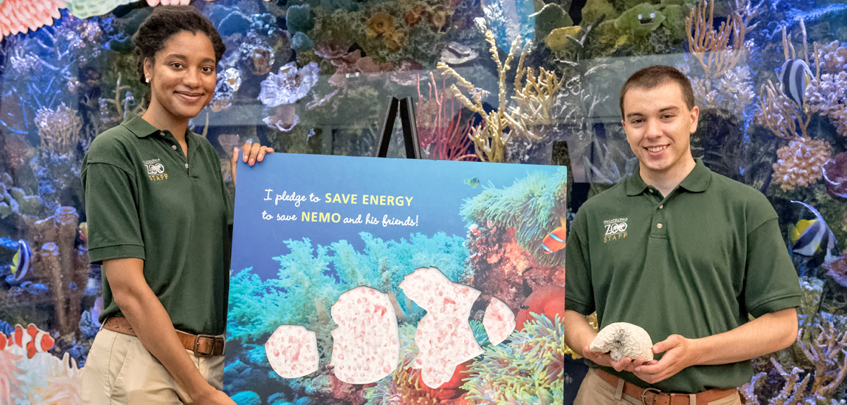
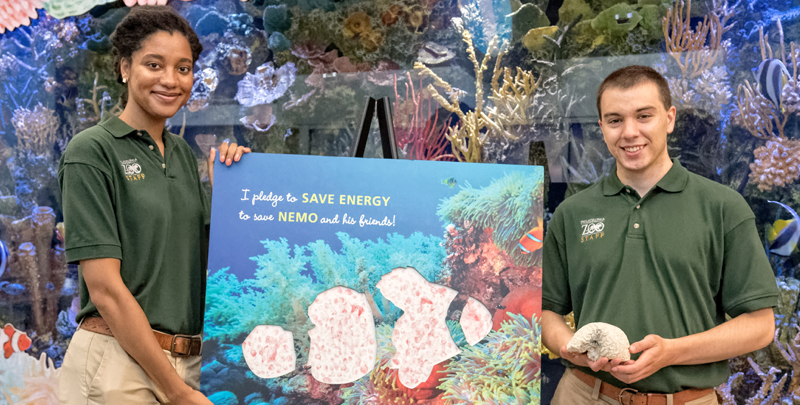
This guest post by Wei Ying Wong of Philadelphia Zoo is the second in a 3-part series on Philadelphia Zoo’s Innovative Solutions Grants+ project. They’re exploring a new way of evaluating long-term conservation behavior change, specifically home energy use, in visitors to the zoo’s KidZooU exhibit. Hi! Welcome to our coral reef exhibit. Are there animals you recognize in here? Can you find Nemo? Clownfish like Nemo and many other species of fish depend on a very special type of habitat called coral reefs. In recent months, visitors to Philadelphia Zoo’s KidZooU (KZU) have been greeted with an opportunity take action to “Save Energy to Save Nemo” when they approach our coral reef exhibit. As discussed in our previous blog, we are capitalizing on a prime opportunity to communicate about ocean acidification at our coral reef tank. While our ultimate goal remains one of testing how well we use onsite conservation messaging to affect offsite behavioral change, we’ve found that getting those permissions and systems in place is a challenge. So to date we’ve focused on fine-tuning our messaging while asking visitors to pledge to reduce their home energy consumption. Early in the new year, our hope is to go one step further with our local visitors, asking not only for a pledge, but for permission to track their home energy usage! Asking for a pledge Our intended audience has been mixed age groups based on the research finding that children can be key influencers on household decision-making, and, fortunately, mixed age precisely describes most of the visitor groups to KZU. When visitor groups approach the coral reef tank, a zoo interpreter engages them in a conversation about the reef and other organisms in exhibit using strategic framing techniques that help visitors understand climate change and ocean acidification by overcoming traditional barriers and cuing people to think productively about solutions (see National Network of Ocean and Climate Change Interpreters for more details). On concluding the interpretation, we ask visitors to take a pledge to reduce their household energy consumption (“Save Energy to Save Nemo”), with children “signing” the pledge on behalf of their families by inking their fingerprint on a clownfish cut-out. Initial Findings To date, we have monitored our engagements with more than 600 people (in a total of 198 groups, with group sizes that varied from 1 to 12 people). Here are our preliminary findings: KZU visitors are open to a conservation message, provided there is no language barrier Almost three-quarters (73%) of the total number of groups stayed for at least a portion of the narrative. If they stayed through the first section, they were highly likely to stay on for the entirety of the message. While all visitors appeared to be generally happy when our interpreters approached them, we were not able to engage with about 5% of our visitors on account of the language barrier. Moving forward, we would like to include interpretation in other languages, especially as The Ocean Project’s market research indicates that households where English is a second language are likely to be very interested. KZU visitors are willing to take action on this issue Among the groups that stayed engaged with our interpreter till the final ask (“Pledge to Save Energy to Save Nemo”), 92% of the groups had someone take pledge to make a difference for the animals and their habitat. Overall, that represents almost half (42%) of the total number of people engaged. Engaging the child is critical to engaging the group Graph 1: Showing the percentage of people who left the interpretative station for the respective reasons As noted above, we noticed that if a group stayed through the full message, they had a high likelihood of pledging to take action (twice as likely as if they left early) With that in mind, we looked at why some groups were leaving early and found, as can be seen in the graph, that the biggest factor was whether the child stayed engaged. In most cases, especially when the child was young, adults allowed the child to determine their course. So when they child was no longer interested, the group left. Leaving the ask to the end might not be the best way to go While we continue to look for ways to keep the attention of the children, we’re also going to try moving the ask to the beginning. By doing so, we anticipate a significant increase in the number of groups who will make the pledge. Graph 2: Showing the percentage of people who leave the interpretive stations at various points of the narrative Inking a fingerprint works well for children, but not for adults The act of pledging by inking a fingerprint on a clownfish cut-out is, of course, an activity targeted at children. And as such, it has worked well. We even saw many of the adults who stayed through the interpretation bringing their children back to ‘fingerprint’ a pledge. But the number of adults willing to do so was quite low. Plus, of course, moving ahead we are likely to need more formal permission that a fingerprint would provide! Referencing Nemo was not helpful We had hypothesized that the hyper-personalized linkage between action and an identifiable animal character would increase the likelihood of engagement. We were wrong. Instead, the inclusion of “Nemo” created confusion as some of the younger children have not watched the movie, or the visitors’ attention is less interested in the clownfish than other things in the exhibit. So moving ahead, we have our interpreters paying attention to the organism that is capturing the attention of the visitors and then using that as a springboard into the script. Meeting the visitors where they are at is promising to be a much more successful approach. Next Steps We are now in the stages of finalizing the logistical and legal details for tracking the efficacy of our onsite messaging in changing offsite behavior. While that aspect of the project has taken a longer time than expected, the conversations it has generated both internally and with an ever-expanding number of partners is exciting. Moreover, we have learned all of the above lessons about how best to shape our messaging.
Continue reading -
Seas the Day in March – Green Transportation Choices
”Everywhere is walking distance if you have…
Continue reading -
Poll: Red or blue, regulate CO2
Results from a national survey conducted in late 2013, and made public yesterday by the Yale Project on Climate Change Communication and the George Mason Center for Climate Change research, show strong support for action among Americans of every political orientation. A whopping 83% of Americans say "the U.S. should make an effort to reduce global warming, even if it has economic costs." In a sign of hope for generating the political will to do what needs to be done to ensure a healthier climate and ocean, and a sustainable society for the future, majorities of both Democrats and Republicans support national action on climate and energy policies. Majorities of Americans in red, blue, and purple states support: providing tax rebates on the purchase of energy efficient vehicles or solar panels; funding more research into renewable energy sources; regulating CO2 as a pollutant; and eliminating all subsidies for the fossil fuel industry. From ClimateProgress: "In general, Americans want less fossil fuels and more low-carbon energy — with many willing to pay more for those benefits: 67% want to regulate carbon dioxide as a pollutant 59% want to cut fossil fuel subsidies entirely — while 60 percent think cutting renewable subsidies is a bad idea 56% would pay an extra $100 a year if it meant their electric utility was required to produce more than 20 percent electricity from renewables 72% want more research funding for renewable energy" For the complete study, "Public Support for Climate and Energy Policies in November 2013," please link here. Also, stay tuned as we will soon be releasing action guides, specifically to help our partner network effectively engage their visitors and the public in helping with solutions to climate change and ocean acidification through green power opportunities around World Oceans Day.
Continue reading -

Communications medley: Solar boom, car crash
In this week's round up: finding common ground on our values, a crash in Americans commuting by car, DON'T buy buy buy - for the children, and more. If you’re a science communicator or educator at an informal science center (such as a zoo, aquarium, or museum) trying to encourage conservation action – this is the round up for you! Every week we break down the most interesting recent news and best resources to help you frame the issues as effectively as possible. Some of these resources will be practical communications and framing tips, and others are great starting points for brainstorming future strategies. Jump to... Thoughts on communication By the numbers Thoughts on communication It's what we all are striving to figure out - how can we communicate with other people in a way that leaves an impression? Here are some thoughts that may help: Climate communication: know thy audience, know thyself It's critical to keep your target audience in mind when communicating - but it's also important to know your own strengths and weaknesses as a messenger. Douglas Meyer shares some thoughts in this mini-blog. Finding the Common Ground This interesting post by Lightbox Collaborative isn't specifically about environmental issues, but it's definitely applicable. You may know that there are six fundamental morals most humans identify with (fairness, respect for authority, etc.) but did you know that political ideologies give these values very different weight? However - that doesn't mean you can't talk about issues traditionally seen as "liberal" using "conservative" values. This post gives some tips. Is Every Day Black Friday? How Climate Inaction And Hypermaterialism Betray Our Children It's a confrontational headline but it makes a common sense point - if you care about the future of our children, buying them junk for the holidays is self-defeating. 1/4 of America's energy use goes to creating products. Pair that with the fact that, in general, we value positive experiences over nice material possessions. By the numbers Stats, polls, all the new developments by the numbers. The US has 43 nuclear power plants’ worth of solar energy in the pipeline A lot of this is still in the planning stages, but there is a bright future for US solar power. Lame pun certainly intended! I like this article for talking with people who are still unconvinced that solar power is an up-and-coming energy source in America. Car commuters declining in 99 out of America's 100 largest cities There is a small but significant shift happening in the way America's city dwellers are getting around, and it doesn't seem to be due to the economy. This is a great stat to use when talking to people about biking and using the subway to travel - it's green and lots of people are doing it.
Continue reading -
Communications medley: the grandkids won’t be alright
In this week's round up: the grandkids won't be alright (if we have anything to say about it), making ocean connections, and a bit of good news. If you’re a science communicator or educator at an informal science center (such as a zoo, aquarium, or museum) trying to encourage conservation action – this is the round up for you! Every week we break down the most interesting recent news and best resources to help you frame the issues as effectively as possible. Some of these resources will be practical communications and framing tips, and others are great starting points for brainstorming future strategies. Sorry grandkids, we don't care! A new study has come out that spawned a variety of eye-catching headlines. "Delayed gratification hurts climate change cooperation!" "People don't put a high value on climate protection!" And my favorite "Why We Don’t Care About Saving Our Grandchildren From Climate Change." These are all articles worth reading. The short version is that American and German researchers conducted a "collective-risk group experiment," the results of which support something you may already suspect: groups of people are unlikely to sacrifice much themselves to benefit future generations. We need short-term incentives to act. Of course, assuming this study was done on WEIRD (Western, Educated, Industrialized, Rich, and Democratic) people... here's another argument for diversity in the environmental movement. Making connections Conservation and environmental actions can be hard to communicate; here are some stories that may help make the connection. Latinos Lead the Way in the Green Economy Speaking of diversity, here are some numbers: by 2050, 33% of American workers will be Latino. Almost 90% of Latinos polled "said they'd prefer to work in clean energy industries than fossil fuels." Warmer oceans put Northwest streams at risk Making the connection between ocean health and the local community can be a toughie for communicators who work inland. This article describes how warmer oceans affect animal life in rivers; a local story like this can provide an opportunity to talk about animals, local habitats, and actions people can take to help turn things around. More Americans die from car pollution than car accidents This is a bit morbid but definitely a "sticky" message. In the US, pollution from cars kills more people than traffic accidents. Which do we fear more? And finally... some good news CHARTS: US Carbon Emissions Are Dropping US carbon emissions from energy use dropped almost 4% between 2011 - 2012! Not only that, but the GDP grew during this time. Reducing energy consumption doesn't mean the economy will suffer. What's more? HALF of the cuts came from reductions in household energy use!
Continue reading -
Seas the Day in October – being energy e(FISH)ent
The Seas the Day initiative encourages and empowers people to take ocean conservation personally. Each month, we feature a new conservation theme with ways to help so come back regularly for more ocean-friendly ideas and tips! Created mainly to support our partner ZAMs (Zoos, Aquariums, and Museums and other visitor-serving organizations involved in our growing network) in their efforts to motivate conservation action with their visitors, Seas the Day is for you to tailor for your own purposes. Please use any of the content verbatim and re-post on your own blog, social media channels, website, newsletter, etc. We have a large database of action tips and related content for you to use. Let us know what’s most helpful and what other types of information and resources we can provide to enhance your efforts to motivate action for the ocean. Seas the Day in October – Save Energy, Save the Seas! "We simply must balance our demand for energy with our rapidly shrinking resources. By acting now we can control our future instead of letting the future control us." - Jimmy Carter Save energy to save our seas. As winter approaches, now is the time to take some simple steps toward a more energy-efficient home. The generation of electric power produces more pollution than any other industry, resulting in acid rain, urban smog, and global climate change, all of which harm our ocean. In the United States, October is National Energy Action Month. What action will you take to save energy this month? It’s as easy as flipping a switch. It’s so easy to forget, but yet so easy to do. Every time you walk out of a room turn off your lights, fans, computer monitor, anything that is using energy that you won’t use when outside the room. Same idea; if you plan on sitting in your car for more then a couple seconds, just turn your engine off. It’s actually hard to imagine how much energy people could save if everyone consistently turned things off when not in use. Be a star with Energy Star. If you are in the market for new appliances or even just a light bulb, try getting the most energy-efficient products. Look for products with an Energy Star rating. Today, energy efficient appliances are doing the same job but with substantially less energy than their older counterparts. The choices we make like choosing a laptop over a desktop or saying no to the electric can opener will all contribute to the ambition of saving a lot of energy. Make the push for clean, green energy sources. Renewable energies like solar and wind power are becoming more and more popular sources that can supply our communities with clean energy. By educating yourself on green energy generation, you can become more engaged in the community, state, and nation wide discussions on where we get our energy from in the future. Check with your local utility company for options to buy affordable, renewable green energy. If you think renewable energy systems could work well on your property, research what state and federal incentives exist for installation. Find out more energy-saving tips!
Continue reading