-
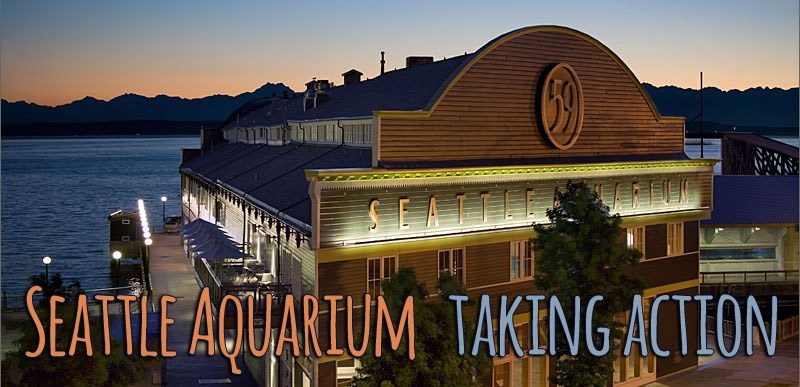
Taking the dive part III – Seattle Aquarium takes action for World Oceans Day
In Part I of our series on conservation asks at World Oceans Day events, we explained the concept of seizing these unique opportunities to encourage your visitors to take environmentally-friendly actions (conservation ‘asks.’) In Part II of the series, we introduced you to how an innovative pilot program at California Academy of Sciences is exploring how to best make conservation ‘asks’ by interpreters through a collaborative professional learning program. In this installment, Part III, we’ll take a look at how Seattle Aquarium has made conservation ‘asks’ an integral part of their World Oceans Day celebrations in 2012 and 2013 – and what they’ve learned from the experience. Seattle Aquarium takes action Seattle Aquarium’s 2012 and 2013 celebrations had a strong conservation orientation – the institution definitely doesn’t shy away from civic engagement. In 2012 they focused on messaging about ocean acidification, marine debris, and MPAs. For 2013 they narrowed the focus more by encouraging action on ocean acidification and marine debris. To help in these efforts, the Seattle Aquarium has turned to their youth advocacy volunteer group, Puget Sound: We Love You. The group has run the ‘Hour for the Ocean’ campaign , leading to hundreds of people in the Seattle area taking one hour on June 8th to do something clean up their local watershed. For 2013 the aquarium experimented taking it to the next level with the ‘Be an Ocean Hero’ campaign. Each station at their World Oceans Day event presented three actions visitors could take to protect the ocean: on an individual, community, and civic level. They supported these recommendations by giving examples of what the aquarium was doing as well. The aquarium implemented consistent messaging on multiple levels: they presented the same action tips in a blog post prior to the event, pushed them out via several social media posts prior and during, and had docents repeat them during interpretation with guests at various stations. Lessons Learned So what did Seattle Aquarium learn from their experience which could help other institutions encourage their visitors to take action for environmental health? Focus on fewer issues. This provides a consistent narrative and doesn’t leave guests overwhelmed. The Seattle Aquarium, for its part, plans to continue to use effective story telling and strategic metaphors to emphasize one or two of the most prominent issues for their local marine environment. Emphasize local impact. A local narrative helps visitors see why the actions - whether individual, community or civic actions - are relevant to them personally, and encourages local pride. It also is much easier for visitors to understand, accept and appreciate than impact on "the ocean." Use animal ambassadors. Visitors care about the animals and want to help. With this in mind, the aquarium incorporated conservation action into their harbor seal presentation. Nicole Killebrew, Marine Science Interpreter shared the following example: “One of our primary themes this year was marine debris. Using our harbor seals as ambassadors for the local wild population, we facilitated a series of enrichment presentations to demonstrate the impact that marine debris has on marine mammals... At the end of the presentation, we received streams of visitors encouraging us to do this type of presentation every day because of the messages’ relevance and importance.” Encourage the sharing of stories. Certain activities can also give visitors a chance to talk to other guests about what they themselves are doing, spreading the knowledge and normalizing ocean protection as a part of responsible citizenship. Nicole recalls: “A guest responded to our ‘Oceans of the World’ activity by sharing their involvement in donating to various organizations that promote coral reef conservation and ocean health...The conversation was rich with ideas about ways people can get involved in supporting grassroots organizations that are making a difference.” Thanks to Nicole Killebrew, Dave Glenn, and Becky Bingham at Seattle Aquarium for their great help, insight, and willingness to share their experiences. If you’d like to share how your institution is inspiring visitors to help the environment, please don’t hesitate to email us.
Continue reading -
Applying research, inspiring recycling
Two of our partners recently reported on efforts to improve on-site recycling by applying some of the lessons learned from the communications research. Their efforts, each sparked by strategy sessions with The Ocean Project, brought impressive results as well as ideas for improvements. The Virginia Aquarium and Marine Science Center In the summer of 2012, staff at the Virginia Aquarium & Marine Science Center conducted a three part pilot project to see if they could help raise awareness and inspire action around the issue of marine debris, as measured in large part by less trash on the ground and more recyclables in the bins of their campus. To begin, they established a baseline by - you guessed it - counting trash and surveying visitors with thanks to a great team of volunteers. Next, they installed new cigarette butt bins and recycling containers and again counted trash and conducted surveys. And, finally, they installed inspirational signs with a focus on trash impacts on animals, and completed a third round of surveys. Based on The Ocean Project's research, the staff went into the project expecting visitors already to have high awareness of the problem of marine debris as a threat to the ocean. Their surveys confirmed this to be true. They also expected that visitors would welcome the new signs with information about how proper trash disposal and improved recycling could help conserve the ocean, especially as connected to the fate of the animals. This too proved to be true (And, not to be overlooked, the positive response extended beyond visitors to staff and volunteers as well). But did it work in terms of reducing trash and improving recycling? Yes, though perhaps not as much as they would have hoped. There was a notable and steady improvement, especially in terms of reducing the number of cigarette butts to be found on the ground, yet the counting of individual trash items may have affected their ability to effectively measure the remainder of their results. "The communications research from The Ocean Project helped us shape our effort, and we certainly confirmed that our visitors welcome our suggestions as to how they can help us conserve the ocean. We also learned that these efforts don't have to be high cost to be high impact." - Mark Swingle, the aquarium's director of research and conservation Texas State Aquarium Also during the summer of 2012, staff at the Texas State Aquarium was trying a similar experiment. They too had become frustrated at the way in which some of their visitors tossed trash on the ground, and failed to put bottles in recycling bins. Staff applied the major lessons of The Ocean Project's communications research, and also took advantage of the story they could tell about Tiki, a sea turtle, who was rescued after ingesting a plastic bag and becoming entangled in fishing line. Their approach emphasized augmenting existing signage by having their interpreters convey three simple, research-based messages, then counting the number of bottles being recycled and surveying guests for their opinions. The messages were as follows: Animals can get sick by eating plastic or get tangled in it(Based on the research finding that problems are more likely to be of concern when connected to their impact on specific species, such as species of sea turtles) Thanks for helping protect the animals by throwing away your trash and recycling plastic(Based on the research finding that guests tend to see themselves as part of the solution, not part of the problem --- even if they are both!) The Aquarium helps animals through its rehab program (To help reinforce the standing of the aquarium, and, as such the trust in its recommendations) The results? Guests left fewer items overall and 40% fewer plastic bottles in the stands after the Dolphin Bay and Wild Flight shows - wow! Staff, however, was somewhat disappointed by the way, albeit not unexpected way, in which increased action seemed unconnected to improved awareness. While more guests did cite plastics as a problem for turtles in the exit surveys, it was unclear if overall awareness of the problem of marine debris increased. Even then, the staff reported feeling that the effort was worthwhile and much was learned, and, of course, that 40% is not to be tossed away! The Ocean Project will continue to share stories from partner experiments in this blog. Have one for us? Please send it along!
Continue reading -
Taking the dive – conservation asks at World Oceans Day events
This is the first in our series of posts…
Continue reading -
Lessons Learned: Best Practices for Youth Campaigns
Working with youth is incredibly important for the future of environmental protection. Not only has our communications research told us youth of today are the most socially conscious and environmentally aware generation with the most household influence on environmentally responsible actions, another recent study shows “(not) since 1972 has a generation played such a significant role in voter preferences as it has in recent elections”. This is great news for our efforts with zoos, aquariums, and museums (ZAMs) to encourage a youth movement for ocean conservation. They are clearly passionate and do not shy away from taking personal action, whether politically or in their personal lives. Therefore, the question for us in our efforts to communicate for action is not “How can we make them care enough to act?” but “How do we empower them to take meaningful action for conservation?” The Ocean Project has been working with a ZAM partners---Seattle Aquarium, North Carolina Aquarium at Fort Fisher, New York Aquarium, Lincoln Park Zoo and Chicago Botanic Garden---on precisely this issue and seeing promising headway. Seattle’s P.S. We Love You campaign has already seen significant success in motivating teen volunteers to take action and inspire their friends and families to action, while NC Fort Fisher’s Beach Reach utilizes social media to “bring beaches back to life, pier to pier and peer to peer”. Here are some of the lessons we've learned through these campaigns: Cross-discipline support. The first step in planning a campaign is to discuss goals and strategies with the cultural organization’s staff. It is best if a healthy cross-section of staff from different disciplines attends this workshop, even if they will not be heavily involved in campaign activities. This helps to garner buy-in and support from the entire organization. And it does serve to motivate potential future mentors. Recruit student participants who are already literate on the subject. Research shows and personal experience confirms that students who are already knowledgeable on the subject matter will become more involved and at a faster rate. So if you want to do a campaign related to conservation, it absolutely helps if the youth have already learned about conservation issues and lingo. If the students are not yet literate on the subject matter, the cultural organization can get them up to speed before beginning the campaign. Work with a critical mass of youth participants. In order to have a successful campaign, it really helps to have a robust number of youth participants. Having that critical mass keeps the teens motivated and also accounts for the few who will not remain involved in the long-term. There isn’t an exact right number, but certainly more than 10 are needed. Structure the time and place of campaign work. Youth participants will accomplish far more if they work in a moderately structured environment. Dedicated staff and mentors can structure time by setting results to be accomplished at each meeting and helping teens follow through. The youth participants should also be able to meet in a place with enough space and with access to tools for them to accomplish planned results. Allow students and staff to brainstorm and make decisions. Youth campaigns are a two-way street between students and staff, so goals and decisions should be made in tandem. It’s essential for the cultural organization’s staff to discuss institutional mission and goals, but it is equally important for youth participants to follow their interests and determine their campaign. The interests of staff and students always line up, but it’s key that both groups go through the brainstorming and decision process. Trust them by turning over some control to the youth. All partner organizations have found that giving a little control to their youth participants goes a long way. When given room to be open and creative, students have presented great ideas and tried new things, while always remaining true to the cultural organization’s overall message and values. Appoint a dedicated staff member to champion the campaign. Youth campaigns work best when a staff member takes the lead in overseeing the campaign. The role of that staff member is to support the teens, look out for the campaign’s best interests, and help drive buy-in among other staff members. Finally, when the organization is ready for YouthMuse and The Ocean Project to begin to step back from the campaign, the champion helps ensure ongoing success. Create a schedule for check-ins. After YouthMuse and The Ocean Project facilitate the start of a youth campaign, the cultural organization transitions into taking the lead in continuing the project. Periodic check-ins with YM/TOP are a great tool for lasting success, and can be done via email, phone and Skype. In these check-ins, YM/TOP can help cultural organizations meet their ongoing goals, handle any bumps in the road, and offer advice or additional support. Allow the students to volunteer to participate. Don’t make campaign participation part of the students’ program requirements. The students who are motivated to make a difference will get on board and recruit others. Make it geographically easy to attend. Hold some of the meetings at a neutral location (be sensitive that a school may not be a neutral location) closer to the youth, if they can’t get to your facility. If you can, provide transportation support. Hold meetings in conjunction with other activities (volunteer shifts, program efforts) that bring the students to your location anyway. Keep in touch. Try to have at least monthly meetings. Students get distracted and the relationship must be rebuilt if you don’t engage them on a regular basis. Give service learning hours. Or volunteer points or whatever reward system you have in place for student participation in campaign activities. These students work hard on the campaign; show them it’s important. What have you learned from working with youth?
Continue reading -
Inspiring the Next Generation of Ocean Advocates
“I want to tell you about how the Aquarium…
Continue reading -
NEW: Special Report on the Public Awareness of Ocean Acidification
Back in 2008 The Ocean Project tested the term “ocean…
Continue reading -
Communicating Conservation: Weekly Resources and News
The Ocean Project will be posting weekly roundups of the…
Continue reading
