-
ISG+ Update: NEAq ClimaTeens in the public spotlight for a green future
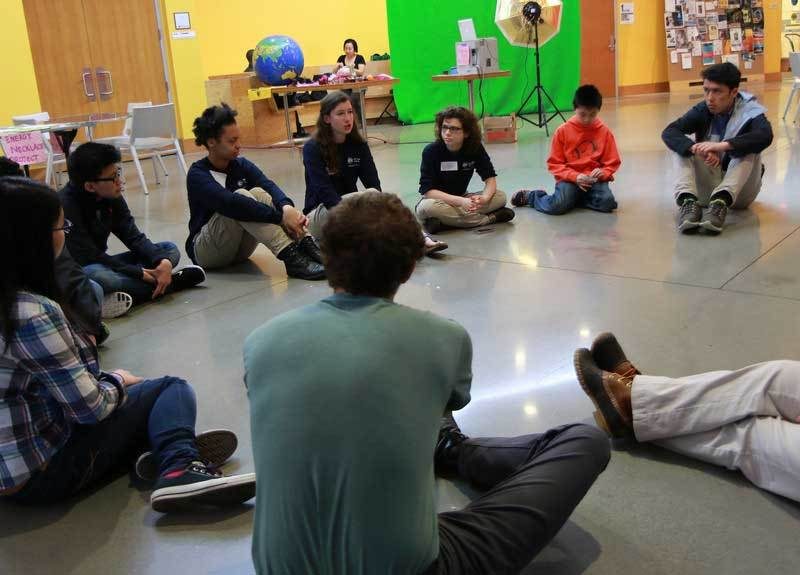
This guest post by Sylvia Scharf of New England Aquarium is the second in a 3-part series on their Innovative Solutions Grants+ project, which investigates how teen ambassadors can make a difference for their city’s green future. The previous post presented the project, this is an update on what's happened since. How do we engage youth in talking about big topics that really matter in ways that are empowering and interesting? This year, the New England Aquarium’s ClimaTeens took on the challenge of talking about climate change. The group was formed from interested teens who already had been involved in Aquarium programs as volunteers, interns, and members of our service-learning program. The initial goal was for the teens to lead a training day for their peers. But given the energy of participants and staff members, and with support from The Ocean Project’s Innovative Solutions Grants + Program, we ramped up our plans and set a new goal of empowering the teens to inspire others to take action. Our first step was to ensure that the teens felt confident when communicating about climate change. During the fall and early winter, the group spent many hours building their understanding of core climate science content and communication theory. Early this spring they began developing presentations to share. ClimaTeens in action When a surprise call came from the office of EPA Administrator, the ClimaTeens were ready. They presented as part of an Earth Day press event with EPA Administrator Gina McCarthy and Energy Secretary Ernest Moniz, as well as Massachusetts Senator Ed Markey, and Boston Mayor Marty Walsh. From that high note, ClimaTeens engaged audiences at several meetings and conferences including the Youth Climate Action Summit at MIT, the Massachusetts Environmental Education Society annual conference, a Career Pathways workshop at the Aquarium, and the Aquarium’s World Oceans Day celebration. Each presentation featured different ClimaTeen presenters, bringing individual voices to the fore. At the end of the school year, we asked the ClimaTeens to reflect back on their growth, and what they might look for in the future. Here are some of their reflections, showing that they had become much more confident. “Before, I was under the impression that climate change was too “big and scary” to tackle on my own, or even with a group. However, now after having been through the ClimaTEENs program, I can say with confidence climate change is a solvable problem (if we do take action).” (Grace C., 17) “I feel like the reason teens are valuable in the fight against human caused climate change is that we lack the limits that adults do in the terms of problem solving.” (Grace L., 15) “My whole family has changed because of my relationship with the aquarium. All of our decisions on purchases and transportation have definitely changed.” (Vida, 17) These reflections also indicate how important the community has become to participants. In working with teens in this kind of setting, social bonding is as important as the science learning. Even though our meetings were only two hours, once a month, the first 15-30 minutes of each meeting was devoted to pizza, chatting, checking in, and joking around. As an educator, the temptation to ‘make every second count’ can work against the importance of teens as social learners. Meetings were sometimes chaotic and full of chatter – but we managed to get amazing things done through it all. As one of the ClimaTeens said, “We could be a really big deal.” Looking forward - asking for action With that success, we’re gearing up for our second step, and we’re upping the ante with a goal of inspiring action! This session’s ClimaTeens - which will include some veterans as well as some new recruits - will have multiple opportunities to put the strategic framing and communication skills they gain into practice – through Blue Discovery Family Days at the Aquarium. And to test their impact, the teens this fall will survey visitors to see if those who heard them were indeed more likely to get the connection between climate change and ocean health, feel empowered to make a difference, and express a willingness to take one or more of the following actions: Wash clothing in cold water and/or let it air dry Have an energy expert conduct a free home energy audit for their house or apartment (through an already established city program) Join a community-based effort, such as Greenovate Boston or the New England Aquarium's live blue Ambassadors Stay tuned for the results! -- Sylvia Scharf, Senior Program Educator at New England Aquarium
Continue reading -
Round 2: Innovative Solutions Grants+ winners announced!
Thank you to our partner organizations for your involvement in advancing aquatic and ocean awareness and conservation! For over 16 years, The Ocean Project has been supporting our partner zoos, aquariums, and museums (ZAMs) and other organizations do more for conservation action with visitors, both onsite and online, by providing strategic resources and tools to more effectively educate and communicate with your visitors for conservation outcomes. Most recently we developed an Innovative Solutions Grants+ Program to help engage visitors with solutions to ocean and climate issues. Thanks to funding from the National Oceanic and Atmospheric Administration (NOAA), we award grants to innovation leaders (currently $100,000/year for a few zoos and aquariums) that also come with pro bono strategic communications coaching throughout the grant period and technical expertise to catalyze peer-to-peer sharing and learning. The lessons learned benefit the aquarium and zoo community as a whole. Thank you to all who applied for a grant from the Innovative Solutions Grants+ Program. For this second round of support, we had very strong proposals from zoos and aquariums around the country, and our Advisory Panel had a challenging time selecting the winners. We are pleased to announce the following grant recipients: Philadelphia Zoo: Awarded $30,000 to measure the connection between onsite messaging and offsite behavioral change. To quantify the impact of the Zoo's mission-related conservation-education messaging on visitors, and to link Zoo visitors with ocean issues, they will develop a pilot project that will message ocean acidification (OA) at their Coral Reef Tank exhibit in their new KidZooU: The Hamilton Family Children's Zoo & Faris Family Education Center. The Zoo will leverage their partnership with PECO – the energy supplier for the Greater Philadelphia region – and Opower, to measure and compare the energy consumption behavior of Zoo visitors who have been exposed to OA messaging and asked to "save energy to save wildlife" with that of non-Zoo visitors, as well as visitors who have not received Zoo interpretation about OA. Riverbanks Zoo and Garden: Awarded $12,000 to create a year-long immersive program for its ZooTeens. The program, dubbed Teen S.O.S. (Stewards of Our Seas), will feature three main elements: 1.)Teen Action; 2.) Community Action; and 3.) TeenMD (marine debris), the first in a series of S.O.S. action kits. Teens will create innovative art from waterway cleanups and engage in peer-to-peer teaching as they weave the topic of marine debris into interactive programming for guests of all ages and inspire action through a teen-developed "Plastic Pledge - Take Back the Bag" campaign. The Florida Aquarium: Awarded $28,400 to work with the entire school community of a local Title 1 elementary school where many children are not getting a lot of hands-on science programming and where approximately 50% of the student population report English as a second language. This project will strive to increase participation of students' families in climate change-related activities and will include development of curricula and related materials in Spanish, that will be shared broadly. Woodland Park Zoo: Awarded $28,000 to engage their community in climate change, sustainability and conservation action by leveraging the collective energy and enthusiasm of their youth participants. Teens will develop their own carbon reduction action campaign that they will participate in and encourage participation in from their peers. Their project will focus on three primary areas: 1) Training: Develop and implement a comprehensive training/workshop for teens on climate science, interpretive practices, and strategies in developing social marketing/action campaigns and projects; 2) Action: Create the Seattle Youth Climate Action Network made up of teens from WPZ, Seattle Aquarium and the Pacific Science Center. Teen leaders from each will develop and implement their own action campaigns/projects; and 3) Communication: Support teen participants through engaging in a collaborative process that enriches teen experiences within each institution while providing opportunities for them to come together to learn and share throughout the year. Congratulations to the winners and The Ocean Project looks forward to working with all our partners in 2015 and beyond, to help communicate strategically for conservation action outcomes and impact. We will be releasing another RFP at some point in 2015 so watch the blog and our website for further information. Image via Shutterstock.
Continue reading -
ISG+ Update: Oregon Coast Aquarium teens set out to slay vampires
This guest post by Teresa Mealy of Oregon Coast Aquarium is the second in a 3-part series on their Innovative Solutions Grants+ project, exploring the question “How do we fuel behavior changes in teens to decrease their impact on ocean acidification?” The Oregon Coast Aquarium’s youth volunteer group has been busy learning the ins and outs of social marketing in preparation for launching a campaign this fall. The group, which is calling itself the MOANA Group (Making Ocean Acidification Nationally Aware), is comprised of four highly motivated and enthusiastic youth. With a goal of promoting actions by their peers that would help address the issue of acidification, the teens, who already were informed on the issue, realized that their next step was to research the social marketing process, and challenge themselves to think outside the box. Social marketing skill building The Aquarium brought Action Research, a community based social marketing consulting firm, to fast-track the youth volunteers’ understanding of how social marketing can influence positive changes to their peers' behavior. After an overview of social marketing, the teens launched into formulating behavior “asks”. Each student developed and researched at least five behavior changes that would result in lower carbon dioxide emissions, reducing its absorption into the oceans. MOANA’s volunteers generated a list of over 20 behavior changes that could make a difference! The Group then gathered to determine which actions would best fit their audience and project’s mission. Narrowing down the “ask” To reduce the list from 20 to four, the teens collected input from friends and family on relevancy and ease of implementation. One of the key steps of social marketing is to minimize the barriers between the ask and its adoption. With that in mind, the group eliminated many of the potential asks, which were considered less relevant to their peers, such as when the teens themselves would not be the ones making the ultimate decision, or, too difficult to implement, such as when the ask required a very high investment of time or money. For example, asking teens to install solar panels on their homes was an original idea, but after consideration it was eliminated for these two reasons. To identify more promising asks, the youth volunteers conducted in-depth interviews with their peers. These interviews gave the group a better understanding of, not only the potential barriers to a behavior change, but also the impacts the change could have. The interview process was somewhat laborious, with some interviews lasting over an hour. However, the group gathered great insight into how to communicate with their peers and about potential opportunities teens have to impact their household. After discussing the results of the interviews, the teens narrowed their list of four behavior asks to one! MOANA’s ask will be to encourage teens to turn off and unplug computers and game consuls when not in use. Not only do their peers feel they have control over that action, but it is one with a surprising potential for impact, with one recent report noting that, “a typical family spends $120 dollars per year on the so-called 'vampire appliances,' from cable and DVR boxes to cordless phone chargers, microwave ovens and video game consoles. Next steps The final process before implementing the campaign is surveying the target demographic to develop a baseline understanding of what teens are currently doing with their game consuls and computers. Now that school is back in session, the teens will survey their classmates and Oregon Coast Aquarium visitors. While this data is collected, the teens will work with another consultant, and the team from The Ocean Project, to develop an evaluation process for their efforts, looking at questions such as: Did their peers take the action? And how did they feel about being asked to do so? With the surveys, campaign implementation and evaluation, the students look forward to a busy fall! Community-based social marketing was foreign to all of the teens in the spring. Now, they are not only much more comfortable with the method, they are ready to change the world!
Continue reading -
ISG+ Update: NC Aquariums on the (green) power of interpretation
This guest post by Windy Arey-Kent of NC Aquarium at Pine Knoll Shores is the second in a 3-part series on NC Aquariums' Innovative Solutions Grants+ project, aimed at testing different approaches to engaging guests for conservation action at aquariums. This blog post is a mid-way update on the program. The North Carolina Aquariums, with support from The Ocean Project's Innovative Solutions Grants + Program, are engaging in an experimental program this summer to encourage our visitors to help the ocean and its animals, as well as themselves, by purchasing Renewable Energy Certificates (REC) for their homes. This also is helping our aquariums reach our own clean energy goals thanks to the watt-for-watt match provided by our partner, Greenlight Energy. By using the same "ask," – purchasing a REC - but different approaches at each of our four facilities, we are able to contrast and compare effective strategies across our sites. We aimed to measure success not only in the number of RECs purchased, but in visitor and staff experience with visitor exit surveys and staff interviews.. We've learned a lot so far, and will be making some adjustments so as to have the most successful outcome possible. Here's a quick update! Deploying displays and marketing materials at Pine Knoll Shores A lobby display showing the kWh goal progress at Pine Knoll Shores At my own site, the North Carolina Aquarium at Pine Knoll Shores, we developed a "social marketing campaign" to engage visitors in the REC program. We have a ‘windmill’ display in the Aquarium lobby introducing the REC program, signage throughout the facility, and have had some social media and email correspondence with members. While visitor response to the issue and our ideas has been positive, this primarily passive approach has not been very effective in generating purchases. We did have 259 ‘hits’ to our sign-up website and 43 ‘text to’ hits, but no signups for the RECs. In July, we had significantly more, with 754 ‘hits’ to the website. But at the end of July, we had sold only 903 kWh. Emphasizing interpretative programs at Fort Fisher At Fort Fisher, we are applying a more active engagement approach with a set of interpreter-led programs. These include auditorium programs, where an interpreter interacts with up to 125 visitors; dive shows, where an educator is talking to a diver in the tank; and a feeding at the biggest tank, where an educator narrates while an aquarist interacts with animals. In keeping with the interpretive model developed by the National Network for Ocean and Climate Change Interpretation (NNOCCI), the interpreters explain RECs and the watt-for-watt match, while putting it all into context for their audience. There is a focus on shared values as an inspiration to take action: the current generation’s responsibility to protect the environment for future generations; the interconnectedness of life on earth, especially how humans are impacted by how we treat the environment; and the innovation and ingenuity of America – basically, we have the power to solve this problem! Also, we take care to position this “ask” as fitting the size of the problem, encouraging visitors to join with their community to support a clean energy future. This has been the more effective approach of all four sites! Since Memorial Day weekend we have done 254 formal programs that have included asking visitors to consider the purchase of RECs. With the one-for-one match from Greenlight Energy we have sold over 31,572 kWh in June and July. And, importantly, the program has been really well received by our educators, staff and the public. Providing a kiosk with a trained interpreter at Roanoke Island On Roanoke Island, our approach has been to promote REC’s on site with a touch screen kiosk and pull up banner to draw the visitor's attention, combined with a trained interpreter available to engage the visitor and answer questions each weekday from 10:00 a.m. – 3:00 p.m. -- this approach was promising in theory, but has proven to be challenging in practice. The educator was trained on-site by the Education team and participated in online trainings hosted by Greenlight. He has tried many different methods of approaching visitors – anyone interacting with the kiosk, stopping in front of the banner, or pausing near the display is approached in a cheerful, upbeat passionate way about supporting wind power. He distributes small green cards with a ‘text to’ option for more information about signing up for RECs, and most folks will slip that in their pocket. Visitors have welcomed the information, but very few have followed through. Using a kiosk with informational videos at Jennette's Pier At Jennette’s Pier, there is no educator interacting with the public and explaining the REC program. Instead we have a touch screen exhibit with three short video clips explaining RECs, the watt-for-watt match, and the benefits of wind energy. This has been our biggest lesson learned, as from anecdotal observations, a typical visitor spends less than a minute in front of the touch screen and does not spend time going through the video clips, let alone signing up. Recent results and anticipated adjustments After we had our initial sign-up data and first round of visitor surveys by the end of June, we concluded that at all sites visitors are interested in the issue of clean energy and welcoming of suggestions about how they can take action, but RECs are largely unknown, meaning that they have to be explained and put into context, while the action of acquiring a REC has to be simple, simple, simple. With regards to explaining the RECs, we've seen the power of a trained interpreter, especially when that interpreter is incorporating this ask into a program such as a dive show or feeding and can really connect the issue with the audience. As for the sign-ups, we were surprised that so many wanted to skip that step, preferring to donate money directly, trusting that the aquarium would use those funds towards the purchase of the RECs. Moving ahead, my own site, Pine Knoll Shores, is adding this ask into some small group interpretative programs, and all four of our sites are adding donation boxes, collecting money to purchase REC’s directly rather than requiring sign ups. And we will be continue to look at whether visitors are more motivated to donate when the ask is presented as part of an interpretive program, whether or not the presence of the donation boxes makes a difference, as well as what happens if a small incentive such as a window cling is offered. As the visitation cycle changes and crowds decrease, additional changes may be incorporated at individual sites to help us promote REC’s interpretively and programmatically, which could contribute to higher success. Stay tuned!
Continue reading -
Application now available for Innovative Solutions Grants+ Program
The application form for the next round of the Innovative Solutions Grants+ Program is now available; check out the RFP page for details and to download the application. The Grants+ opportunity is limited this year to US-based zoos and aquariums only. The deadline to submit your proposal is September 5, 2014. Click here to view the RFP and download the application form. Click here for last year's winners. The Grants+ program is an evolution of The Ocean Project’s efforts to help our partner organizations do more to effectively advance conservation action in measurable ways and create a healthier, more sustainable society. It allows us to invest in supporting innovators in the community by providing not only financial resources, but also free strategic communications services and evaluation help for stronger conservation impact. If you’ve got an innovative project or an idea for a twist on an existing project, program or activity that helps shift the paradigm on communicating to inspire conservation action, we want to hear from you! The Grants+ program was created so we can help you succeed in your role as trusted messengers for conservation solutions to ocean and climate issues.
Continue reading -
RFP for new Innovative Solutions Grants funding posted
We are pleased to share our new RFP for the second round of the Innovative Solutions Grants+ program! Click here to view the RFP, we'll be posting the application form shortly. Proposal deadline is September 5, 2014. With thanks to National Oceanic and Atmospheric Administration (NOAA) for helping us establish our Innovative Solutions Grants+ program, this second round of funding will provide $100,000 for AZA-accredited aquariums and zoos that are based in the US. (We are trying to raise funding to expand this opportunity to all our partner zoos, aquariums, and museums (ZAMs) in all parts of the world, so please let us know if you have any ideas for potential funding sponsors.) The Grants+ program is an evolution of The Ocean Project’s efforts to help our partner ZAMs do more to advance conservation action in measurable ways and create a healthier, more sustainable society. It allows us to invest in supporting innovators in the community by providing not only financial resources, but also free strategic communications services and evaluation help for stronger conservation impact. We’re referring to this program as the Grants+ Program because it involves much more than just financial resources. With each grant, The Ocean Project provides financial resources for our partner aquariums to develop innovative local and regional ocean conservation solutions and stewardship initiatives, specifically targeting youth and minorities. We plan to maximize the benefit of each grant by including strategic communications capacity building opportunities for the awardees, including strategic and technical resources and expertise to more effectively engage their visitors. We will also work with each grantee to help accelerate peer-to-peer learning and widely share resulting new strategies and successes with the wider community, especially our growing partner network of 2,000 ZAMs and other conservation and education organizations in all 50 states and worldwide. You can read here on our blog about what the current three Grants+ awardees — North Carolina Aquariums, New England Aquarium and Oregon Coast Aquarium — are doing to bring about positive change. If you’ve got an innovative project or an idea for a twist on an existing project, program or activity that helps shift the paradigm on communicating to inspire conservation action, we want to hear from you! The Grants+ program was created so we can help you succeed in your role as trusted messengers for conservation solutions to ocean and climate issues.
Continue reading -
ISG+ New Project: NEAq ClimaTEENS creating a city-wide dialog for youth in Boston
This guest post by Heather Deschenes of New England Aquarium is the first in a 3-part series on their Innovative Solutions Grants+ project, which investigates how teen ambassadors can make a difference for their city's green future. With support from The Ocean Project’s Innovative Solutions Grants and Program, ClimaTEENS is a gathering of 15-18 year-olds that care about the ocean and who want to contribute to a healthy future. Teens in the program arrived with varied levels of knowledge about climate change, but are united by a desire to learn more about it as an issue of concern and are committed to learning ways to engage public audiences, particularly their peers. With guidance and support from aquarium staff and an introduction to strategic communication theory, participants will develop an in-person presentation to share at three youth oriented conferences annually, create blog posts for the Aquariums website and a video to share through social media. Their messages will be shaped with four themes in mind : Our lives are connected to the ocean Climate change is affecting the ocean Communities are already working to mitigate disruptive impacts of climate change. Youth voices matter Presentations, blog posts and videos will all encourage listeners or readers to join a citywide effort to reduce carbon emissions called Greenovate Boston. Greenovate Boston is a community-driven movement to get all Bostonians involved in reducing the city’s greenhouse gas emissions 25% by 2020 and 80% by 2050, as outlined in the City’s Climate Action Plan. By laying out the necessary steps to reduce the causes of and to prepare for climate change, the Climate Action Plan gives Greenovate Boston a framework for building a greener, healthier, and more prosperous city. The youth voice in the Greenovate effort is growing and we aim to support that growth. In addition, the Greenovate website will allow for ClimaTEENS audiences to: Pledge to take part in carbon emissions reducing activities Invite others to join them in those activities Provide feedback and ideas for future activities and initiatives Greenovate Boston also leverages a growing ambassador program that enables trained Greenovate Ambassadors to host public in-person meet ups where dialog is about climate change and how we can address it. ClimaTEENS will host a meet up for youth before August 2014. We anticipate being able to measure impacts of ClimaTEENS efforts from direct website hits based on our message because the Greenovate website is enabled with a number of built in evaluative properties. For example, in-person audiences of ClimaTEENS presentations will be asked to visit the website and leave a comment referencing the presentation and mentioning an activity the presentation inspired them to participate in. Blog readers and those who watch ClimaTEENS’ video will be asked to reference ClimaTEENS using hash tags as they interact with the Greenovate website. We’re enthusiastic about facilitating connections between youth and the ocean and hope to inspire them to contribute in meaningful ways to a growing community of ocean stewards. ClimaTEENS are helping to support and extend the New England Aquarium mission. -- Heather Deschenes, Manager of Youth Development Programs at New England Aquarium
Continue reading -
ISG+ New Project: Oregon Coast Aquarium sets out to explore empowering youth for change
This guest post by Teresa Mealy of Oregon Coast Aquarium is the first in a 3-part series on their Innovative Solutions Grants+ project, exploring the question “How do we fuel behavior changes in teens to decrease their impact on ocean acidification?” Drive, enthusiasm and passion for change; these are three qualities that fuel the teen members of the MOANA group (Making Ocean Acidification Nationally Aware). Moana, the Hawaiian word for ocean, represents the underlying interest that connects these teens, but also stands for something more. Making Ocean Acidification Nationally Aware, is not just a name or a connection, it is the ultimate goal for this group of driven, enthusiastic and impassioned youth. With support from the Ocean Project’s Innovative Solutions Grants Program, five youth volunteers will examine a single question: “How do we fuel behavior changes in teens to decrease their impact on ocean acidification?” Using social marketing as a foundation, the teens will explore how to create a campaign to encourage positive behavior changes by their peers. For these volunteers to share their campaign with the world, they need to become informed advocates. Their training will include: Training with a community based social marketing guru, with hands-on activities to develop and practice messaging strategies. Webinars with evaluation consultants to zone in on the behavior asks for their peers, and how they’ll measure the success of their efforts. Workshops and field trips to meet with ocean acidification researchers and experts. The youth volunteers will be involved in every step, from creating the messages, to testing the audiences, and evaluating their techniques. In fact, these teens will not only participate, they will lead the process. Their role as decision makers in this project provides a unique set of challenges and rewards for these young volunteers and Aquarium staff alike. The first task the MOANA Group will tackle, after learning some of the basics of community based social marketing, is deciding on the messages they want to test in addition to the campaign’s delivery mechanisms. Ultimately, the goal is for the volunteers to develop and test a campaign that helps them connect with their peers in a way that compels their peers to learn about ocean acidification and change their behavior. With five minds contributing perspectives to the process, reigning in the collective genius to pick and focus on a limited number of messages may prove challenging. Another challenge is the distance and schedules of the youth volunteers. Most of the participants live on the coast, but a few commute from as much as one-and-a-half hours away. To facilitate communication between in-person meetings, the students are familiarizing themselves with Google Hangouts. This technology allows them to meet face to face from miles away to interact and share ideas in a quick, informal setting without taking precious time away from homework or extracurricular activities. The goal of this project is ambitious, and there are undoubtedly many more unforeseen challenges on the horizon, but one thing is certain, it is a goal these teens whole heartedly accept. Their love for the ocean is inspiring and that is a quality they will count on. They hope their passion, enthusiasm and drive will inspire others to care for the oceans, and in turn, help MOANA. -- Teresa Mealy, Youth Programs Coordinator at Oregon Coast Aquarium
Continue reading -
ISG+ New Project: NC Aquariums prepare a green power(ful) experiment
This guest post by Windy Arey-Kent of NC Aquarium at Pine Knoll Shores is the first in a 3-part series on their Innovative Solutions Grants+ project, aimed at testing different approaches to engaging guests for conservation action at aquariums. The North Carolina Aquariums are excited to be working with The Ocean Project on their Innovative Solutions Grant projects in 2014. There are four NC Aquarium sites that are each participating; the Aquarium at Fort Fisher, Aquarium at Pine Knoll Shores, Aquarium at Roanoke Island and Jennette’s Pier at Nags Head. Each of the sites, working in cooperation with Greenlight Energy, will be focusing our efforts to promote and market clean energy in the form of Renewable Energy Certificates (RECs) to our visitors during the peak visitation months of May – September, 2014. The three Aquarium facilities will be testing separate interpretive messages and approaches to see which approach is most effective in motivating our visitors to engage in a specific conservation ‘ask’, and to take personal action by purchasing REC’s for their homes. In turn, each site will receive a 1:1 match from Greenlight; for each REC purchased at a site, that facility will receive a REC to move each of us towards a goal of 100% green power. The pier site, offering a very different facility and path for visitors, will offer this opportunity for visitors through a stand-alone kiosk. There will be similarities at each site in our content, our ‘ask’, and the types of information given to visitors regarding the program and green power, in general. The approach at each site however, is the variable that we will be testing. At Fort Fisher, educators will be utilizing the NNOCCI model (National Network for Ocean and Climate Change Interpretation) of interpretation where emphasis is placed on framing and engaging audiences in a positive way to overcome barriers and think productively about solutions to climate change and ocean acidification. At Roanoke Island, a single conservation educator will be versed in promoting REC’s to visitors one-on-one, and will be able to engage in in-depth conversations about green power, REC’s, and the environmental consequences to living in a carbon-reliant society. A third model at Pine Knoll Shores, will take a community-based social marketing approach that utilizes the principles of conservation psychology to stress the benefits of purchasing REC’s for the Aquarium and its’ animals. The pier site, a LEED (Leadership in Energy and Environmental Design) certified facility with wind turbines and green power showcased on-site, will offer a kiosk where visitors are inspired to action, not through interpretation, but as a result of their visit to the site itself. To evaluate the effectiveness of each approach and method, we will utilize technology provided by Greenlight Energy that offers visitors an on-site ‘dashboard’ for sign-ups through tablets, cell phones or laptops. In addition, there will be a “text to” option for visitors onsite to gain more information on the program or directly sign up to purchase REC’s for their own homes. We will test each approach by measuring: the numbers of inquiries for additional information (texts sent or hits to each individual ‘landing page) how many visitors purchase REC’s visitor satisfaction in the program, using ipad surveys and visitor intercepts at each site. We will then compare the three approaches at the Aquariums to the kiosk at the pier, which relies on the visual inspiration and behavior modeling to inspire action. Progress and results will be disseminated widely amongst our colleagues in the aquarium, zoo and museum communities, both by way of this blog and using sites such as climate interpreter, as well as, we hope, at the AZA annual meeting. Send along a note if you want to know more. We welcome your feedback! - Windy Arey-Kent, Education Curator at North Carolina Aquarium at Pine Knoll Shores
Continue reading


